References · engagement
Muscle engagement and focus: the evidence
Where you put your attention during a set matters, and the two halves of the evidence are not equal. An external focus beats an internal one for performance and learning, in a meta-analysis of 73 studies and 1,824 people. The mind-muscle connection for growth rests on one 8-week study in thirty untrained men.
Is an external focus better than an internal one?
For performance and learning, yes. A meta-analysis of 73 studies and 1,824 participants found external focus superior, whatever the age, health or skill level of the people tested.
Entries by grade: A 2, B 1, C 9, none located 2. What the grades mean.
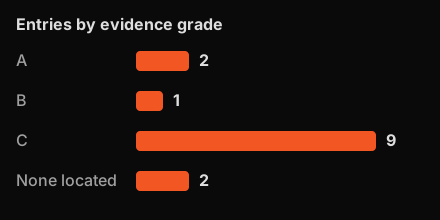
The two halves of this document are not equally evidenced, and presenting them as though they were would be the central dishonesty available here.
The external focus half is strong. A meta-analysis of 73 studies and 1,824 participants found external focus superior to internal focus for motor performance, and for both retention and transfer learning, with the advantage unmoderated by age, health status or skill level [1]. Fifteen years of consistent findings back it across task types, skill levels and age groups, in both movement effectiveness and movement efficiency [2]. This is the best-supported claim in the document and it says: as a default, attention should be on what you are moving, not on the body part moving it.
The internal focus half is weak. The claim that focusing on a muscle grows that muscle more rests on one 8-week training study in thirty untrained college-aged men [3]. Everything else supporting it is acute electromyography, which is a measure of a signal and not a measure of growth. ME-E-02 explains at length why that distinction is not pedantry.
Between them sits the row that actually matters for programming, ME-A-02, and it is graded C: the selective-activation effect disappears somewhere between 60% and 80% of one-repetition maximum [4]. That is a single study in eighteen trained men, and it is the boundary condition MVIII programs against, because it is the only measurement of the boundary located.
Finally, the positional half of this document is largely negative findings, and they are the useful kind. There were no statistical differences in gluteus maximus activation between front, full and parallel squats [5]. There was similar latissimus activation across narrow, medium and wide pulldown grips, despite the wide grip being universally recommended for it [6]. Both refute things coaches say with confidence.
Read the document as: strong on where attention should go by default, weak on the exception, and strongest of all on what the activation literature cannot tell you.
The entries
ME-A-01The default focus is external
PrescriptionUnless a set meets the conditions in ME-A-03, the cue a member is given directs attention to the outcome of the movement (the bar, the floor, the handle) rather than to the body part producing it.
Evidence gradeA
EffectMeta-analyses of 73 studies (1,824 participants) for performance and 40 studies (1,274 participants) for learning found external focus more effective than internal focus for performance (Hedges' g = 0.264, 95% CI [0.217, 0.310]), retention learning (g = 0.583, 95% CI [0.425, 0.741]) and transfer learning (g = 0.584, 95% CI [0.325, 0.842]). Metaregression found neither age group, health status, skill level, nor their interactions moderated the difference (all p > .100) [1]. Fifteen years of research show the advantage extends across task types, skill levels and age groups, in movement effectiveness (accuracy, consistency, balance) and efficiency (muscular activity, force production, cardiovascular response) [2].
Population73 and 40 studies respectively across motor tasks and populations [1]; comprehensive review [2].
CaveatsThe learning effects (g ≈ 0.58) are roughly double the acute performance effect (g = 0.26), so the strongest claim is about skill retained rather than about a single set. Most constituent studies are motor tasks such as balance, throwing and jumping rather than loaded barbell work. The unmoderated result across skill level is the finding that makes this safe to apply to a novice and an experienced lifter alike.
ME-A-02The load above which internal focus stops working
PrescriptionAn internal cue is given only below roughly 60% of one-repetition maximum. At and above that, the member gets an external cue regardless of goal. Band: 60% to 80% of 1RM, standard 60%.
Evidence gradeC
EffectEighteen resistance-trained men performed bench press at 20, 40, 50, 60 and 80% of 1RM under three conditions: regular, focusing on the pectoralis major, and focusing on the triceps brachii. Focusing on a muscle increased that muscle's activity at loads between 20 and 60% of 1RM, but not at 80%. The authors describe a threshold between 60 and 80% rather than a linear decline. The increase did not come at the expense of the other muscle's activity [4]. In a separate study, eleven college football players given verbal instruction to use only the chest or only the triceps at 50% and 80% of 1RM showed the effect at the lower load [7].
Population18 resistance-trained men [4]; 11 male Division III football players [7].
CaveatsThis is the single most load-bearing number in the document and it rests on one study in eighteen people, in one exercise. The threshold is a range, not a line, and MVIII programs the conservative end of it. Whether the 60 to 80% boundary found in the bench press holds for a squat, a row or a curl has not been tested. The effect is on EMG amplitude, which ME-E-02 explains is not growth.
ME-A-03When an internal cue is used at all
PrescriptionAn internal cue is given only when all three hold: the goal is hypertrophy-oriented, the set's role is not a top set, and the load is below the ME-A-02 threshold. Otherwise the cue is external.
Evidence gradeC
EffectThirty untrained college-aged men trained 3 sessions per week for 8 weeks, 4 sets of 8 to 12 repetitions, randomly assigned to focus on contracting the target muscle or on the outcome of the lift. Elbow flexor thickness increased more in the internal group (12.4% vs 6.9%), with similar direction in quadriceps thickness. Isometric elbow flexion strength was greater for internal and isometric knee extension strength greater for external, though neither strength difference reached statistical significance [3].
Population30 untrained college-aged men, 8 weeks.
CaveatsOne study, untrained participants, eight weeks, and a sample of fifteen per group. Untrained people grow from nearly anything, which is exactly the population in which a between-group difference is hardest to attribute to the variable of interest. The strength findings split in opposite directions and neither was significant, which is the honest summary of the strength question: unknown. MVIII gates this rule on three conditions rather than one specifically because the evidence for it is thin enough that its boundaries should be tight rather than generous.
ME-A-04Role outranks goal
PrescriptionWhere the goal and the set's role disagree, the role decides. A hypertrophy-focused member's heavy top set receives an external cue.
Evidence gradeC · derived
EffectNo study located tested this ordering directly. It is derived from two rows that were measured: the external-focus advantage on force production and movement efficiency is the better-evidenced of the two halves [1][2], and the selective-activation effect disappears above the ME-A-02 threshold [4], which is where a top set sits by definition.
PopulationNone. This row is an inference from [1][2][4].
CaveatsDerived, and labelled as such. No trial has compared cueing strategies assigned by set role. The inference is that a set whose job is to move a heavy load should be cued the way the evidence says heavy loads are best cued, and that a member's overall goal does not change what a given set is doing.
# PART B — Engagement
ME-E-01Attention changes measured activation
FindingDirecting attention at a specific muscle raises that muscle's surface EMG amplitude at low to moderate loads, without reducing the other prime mover's activity [4], and verbal technique instruction produces the same shift [7]. In the opposite direction, adopting an external focus reduced integrated EMG during biceps curls while movements were performed faster, and the reduction persisted when movement time was controlled with a metronome [8].
Evidence gradeC · contested
Population18 resistance-trained men [4]; 11 football players [7]; 11 and 12 participants across two experiments [8].
CaveatsNote that [8] points the opposite way from [4] and both are correct: an internal focus raises the target muscle's signal, and an external focus lowers total signal while producing better movement. Less electrical activity for the same or better output is efficiency, not weakness. Reading these two rows as a contradiction is the mistake ME-E-02 exists to prevent.
ME-E-02Surface EMG amplitude is not motor unit recruitment, and it is not hypertrophy
FindingConclusions drawn by comparing sEMG amplitudes across muscles, exercises, techniques and loads, and used to hypothesise about longitudinal adaptations such as strength and hypertrophy, are frequently unsubstantiated and unwarranted [9]. Using "motor unit recruitment" synonymously with EMG amplitude is an incorrect assumption and a common mistake in sports and exercise science, particularly under fatiguing and dynamic conditions, and greater electromyographic responses do not imply greater motor unit recruitment, nor can hypertrophic potential be inferred from them [10].
Evidence gradeC
PopulationMethodological reviews, no primary sample.
CaveatsThis is the most important entry in the document, and it undercuts the evidential basis of Part A's exception and most of Part C. Every acute EMG row here is a measurement of a signal under a condition, not a measurement of growth. MVIII cites activation research to decide which cue to say, which is a low-stakes use, and never to decide which exercise builds more muscle, which is the use these two papers refuse. Graded C as methodological argument rather than trial evidence, and load-bearing anyway.
# PART C — Position
ME-R-01Training at long muscle lengths
PrescriptionWhere two variations of a movement differ in the length of the target muscle under load, MVIII selects the variation that loads it long.
Evidence gradeB
EffectForty-five untrained women trained knee extension in full, initial-partial (lengthened), final-partial (shortened) or daily-varied ranges. The lengthened-partial group showed greater relative increases than all other groups at 70% of femur length, and greater than shortened-partial, full-ROM and control at 50% and 60%; the shortened-partial group was similar to non-training control at 60% and 70%. Strength gains were specific to the range trained [11]. Fourteen untrained adults trained one leg standing (gastrocnemius lengthened) and the other seated (shortened) for 12 weeks; muscle volume increased in the whole triceps surae for both legs except the gastrocnemius of the seated leg, with greater changes for the standing condition [12]. A systematic review and meta-analysis of whether muscle length influences regional hypertrophy is cited in agreement [13].
Population45 untrained women [11]; 14 untrained adults, within-subject [12].
CaveatsBoth primary trials are in untrained participants, and both are single-joint. The regional measurement in [11] is the point: an effect at 70% of femur length and no effect at another site means "the muscle grew" is the wrong resolution for this question. The within-subject design in [12] is a strength, since each participant is their own control.
ME-R-02Range of motion
PrescriptionFull range unless a stated reason exists to shorten it. Partial work is programmed at long muscle lengths rather than short ones, per ME-R-01.
Evidence gradeA
EffectA systematic review and meta-analysis of range of motion and resistance training adaptations is cited [14], in agreement with the regional findings at [11] and [13].
PopulationSystematic review and meta-analysis of range of motion and resistance training adaptations; the prescription itself is specified in the bodybuilding document. [14]
CaveatsThis row exists so that the cueing document does not contradict the training documents. The primary specification of range of motion lives in bodybuilding-programming.md; this entry cites the same works through this document's numbering rather than restating the prescription.
ME-R-03Grip width in the lat pulldown
PrescriptionMVIII does not prescribe a wide grip for latissimus development. Grip width is a comfort and strength variable, not an activation lever.
Evidence gradeC
EffectFifteen men performed 6RM lat pulldowns at narrow, medium and wide grips (1, 1.5 and 2 times biacromial distance). 6RM load was higher with narrow (80.3 ± 7.2 kg) and medium (80 ± 7.1 kg) grips than wide (77.3 ± 6.3 kg; p = 0.02). There was similar EMG activation between grip widths for latissimus, trapezius and infraspinatus across the whole movement, with greater latissimus and infraspinatus activation for wide versus narrow in the eccentric phase only (p ≤ 0.04) [6]. A separate study separating grip width from forearm orientation found the two variables had been conflated in earlier recommendations [15].
Population15 men [6]; 12 healthy men [15].
CaveatsThe authors of [6] state plainly that the belief a wider grip activates latissimus more is a general belief "without any broad scientific support". Small samples, acute EMG, and subject to ME-E-02. The practical finding is the load one: you are weaker with a wide grip and no better activated across the full movement.
ME-R-04Squat variation and gluteal activation
PrescriptionMVIII does not select between front, full and parallel squats on the basis of gluteal activation. Selection is on load tolerance, equipment and the range-of-motion rule at ME-R-02.
Evidence gradeC
EffectThirteen trained women performed 10 repetitions at estimated 10RM of front, full and parallel squats. There were no statistical differences between variations in any of the tested muscles: upper gluteus maximus, lower gluteus maximus, biceps femoris or vastus lateralis. The authors conclude the variations can be performed for similar EMG amplitudes, recommend full range on the basis of other research, and note the front squat may provide a similar stimulus to the back squat despite requiring lighter loads [5].
Population13 healthy trained women.
Sources[5]
CaveatsA negative finding in a sample of thirteen, which is exactly the design least able to detect a small difference. It is cited as a refusal to differentiate rather than as proof of equivalence, and that distinction matters.
# PART D — Findings
ME-F-01External focus produces more output for less signal
FindingParticipants performing biceps curls under an external focus moved faster than under an internal focus, and integrated EMG activity was reduced. When movement time was equalised with a metronome, iEMG remained lower under external focus. The authors interpret this through the constrained-action hypothesis, that an external focus promotes more automatic control processes [8].
Evidence gradeC
Population11 and 12 participants across two experiments.
Sources[8]
CaveatsSmall samples. Included because it is the mechanism sentence for the whole of Part A: external focus is not a motivational trick, it is a measurable change in how movement is controlled.
ME-F-02Push-up variants load measurably differently
FindingKinetic and electromyographic analysis of push-up variants establishes that hand and foot position change the proportion of bodyweight supported [16].
Evidence gradeC
PopulationKinetic and electromyographic analysis of push-up variants; see the progression specification, which is where the ladder built on it is specified. [16]
Sources[16]
CaveatsCited here through this document's numbering; the progression ladder built on it is specified in progression-programming.md, not here.
ME-C-01How many cues to give in a set
FindingNo systematic review or controlled trial establishing an optimal number of verbal cues per set, or the point at which additional cues degrade performance, was located. MVIII caps the cue list at four bullets. That cap is a design decision.
Evidence grade—
PopulationNone.
SourcesNone.
CaveatsSearched for specifically. The attentional focus literature is about where attention goes and is silent on how much instruction to give at once.
ME-C-02Whether an app's cue works like a coach's cue
FindingNo trial was located comparing a cue delivered by software, on a screen or through audio, against the same cue spoken by a present coach. Every study in Part A used verbal instruction from an experimenter.
Evidence grade—
PopulationNone.
SourcesNone.
CaveatsThis is the gap under MVIII's entire cueing feature. The instructions in [1] through [8] were given by a person in a room. Whether a member reads a line on a phone mid-set and attends to it the same way is unknown.
Does the mind-muscle connection build more muscle?
Not reliably. Its whole training evidence is one 8-week study in thirty untrained men, and the effect disappears above roughly 60 to 80% of 1RM.
- That the mind-muscle connection reliably builds more muscle. The entire training evidence for it is one 8-week study in thirty untrained men [3], the acute effect disappears above roughly 60 to 80% of 1RM [4], and EMG amplitude is not a validated proxy for hypertrophy [9][10]. MVIII applies internal cueing only under three simultaneous conditions and states here that it is doing so on thin evidence.
- That higher EMG amplitude means more growth. Refused outright. Inferring motor unit recruitment from EMG amplitude is an incorrect assumption [10], and drawing longitudinal hypertrophy conclusions from acute amplitude comparisons is unsubstantiated [9]. Almost every "best exercise for X" claim in circulation is built on this error.
- That a wide grip works the lats harder in a pulldown. Similar latissimus activation across narrow, medium and wide grips across the full movement, and you are measurably weaker wide [6]. Described by the researchers themselves as a general belief without broad scientific support.
- That front, full and parallel squats differ in gluteal recruitment. No statistical difference in any tested muscle [5].
- That an external focus is only for athletes and beginners should think about their muscles. Metaregression found skill level did not moderate the external-focus advantage [1].
- That more cues make a lift better. Nothing was located on cue quantity in either direction [ME-C-01].
The 16 sources, checked 25 August 2026
- Chua LK, Jimenez-Diaz J, Lewthwaite R, Kim T, Wulf G. Superiority of external attentional focus for motor performance and learning: Systematic reviews and meta-analyses. Psychological Bulletin. 2021. https://doi.org/10.1037/bul0000335
- Wulf G. Attentional focus and motor learning: a review of 15 years. International Review of Sport and Exercise Psychology. 2013. https://doi.org/10.1080/1750984x.2012.723728
- Schoenfeld BJ, Vigotsky A, Contreras B, et al. Differential effects of attentional focus strategies during long-term resistance training. European Journal of Sport Science. 2018. https://doi.org/10.1080/17461391.2018.1447020
- Calatayud J, Vinstrup J, Jakobsen MD, et al. Importance of mind-muscle connection during progressive resistance training. Eur J Appl Physiol. 2016. https://doi.org/10.1007/s00421-015-3305-7
- Contreras B, Vigotsky AD, Schoenfeld BJ, Beardsley C, Cronin J. A Comparison of Gluteus Maximus, Biceps Femoris, and Vastus Lateralis Electromyography Amplitude in the Parallel, Full, and Front Squat Variations in Resistance-Trained Females. Journal of Applied Biomechanics. 2016. https://doi.org/10.1123/jab.2015-0113
- Andersen V, Fimland MS, Wiik E, Skoglund A, Saeterbakken AH. Effects of Grip Width on Muscle Strength and Activation in the Lat Pull-Down. J Strength Cond Res. 2014. https://doi.org/10.1097/jsc.0000000000000232
- Snyder BJ, Fry WR. Effect of Verbal Instruction on Muscle Activity During the Bench Press Exercise. J Strength Cond Res. 2012. https://doi.org/10.1519/jsc.0b013e31823f8d11
- Vance J, Wulf G, Töllner T, McNevin N, Mercer J. EMG Activity as a Function of the Performer's Focus of Attention. Journal of Motor Behavior. 2004. https://doi.org/10.3200/jmbr.36.4.450-459
- Vigotsky AD, Halperin I, Lehman GJ, Trajano GS, Vieira TM. Interpreting Signal Amplitudes in Surface Electromyography Studies in Sport and Rehabilitation Sciences. Front Physiol. 2018. https://doi.org/10.3389/fphys.2017.00985
- Vigotsky AD, Beardsley C, Contreras B, Steele J, Ogborn D, Phillips SM. Greater Electromyographic Responses Do Not Imply Greater Motor Unit Recruitment and 'Hypertrophic Potential' Cannot Be Inferred. J Strength Cond Res. 2017. https://doi.org/10.1519/jsc.0000000000001249
- Pedrosa GF, Lima FV, Schoenfeld BJ, et al. Partial range of motion training elicits favorable improvements in muscular adaptations when carried out at long muscle lengths. European Journal of Sport Science. 2022. https://doi.org/10.1080/17461391.2021.1927199
- Kinoshita M, Maeo S, Kobayashi Y, et al. Triceps surae muscle hypertrophy is greater after standing versus seated calf-raise training. Front Physiol. 2023. https://doi.org/10.3389/fphys.2023.1272106
- Varovic D, Wolf M, Schoenfeld BJ, Steele J, Grgic J, Mikulic P. Does muscle length influence regional hypertrophy? A systematic review and meta-analysis. Int J Sports Med. 2025. https://doi.org/10.1055/a-2615-4935
- Pallarés JG, Hernández-Belmonte A, Martínez-Cava A, Vetrovsky T, Steffl M, Courel-Ibáñez J. Effects of range of motion on resistance training adaptations: a systematic review and meta-analysis. Scand J Med Sci Sports. 2021. https://doi.org/10.1111/sms.14006
- Lusk SJ, Hale BD, Russell DM. Grip Width and Forearm Orientation Effects on Muscle Activity During the Lat Pull-Down. J Strength Cond Res. 2010. https://doi.org/10.1519/jsc.0b013e3181ddb0ab
- Gouvali MK, Boudolos K. Dynamic and electromyographical analysis in variants of push-up exercise. J Strength Cond Res. 2005. https://doi.org/10.1519/14733.1