

M
A thousand
The Roman thousand. The long haul, the part no one sees, counted in days rather than sessions.
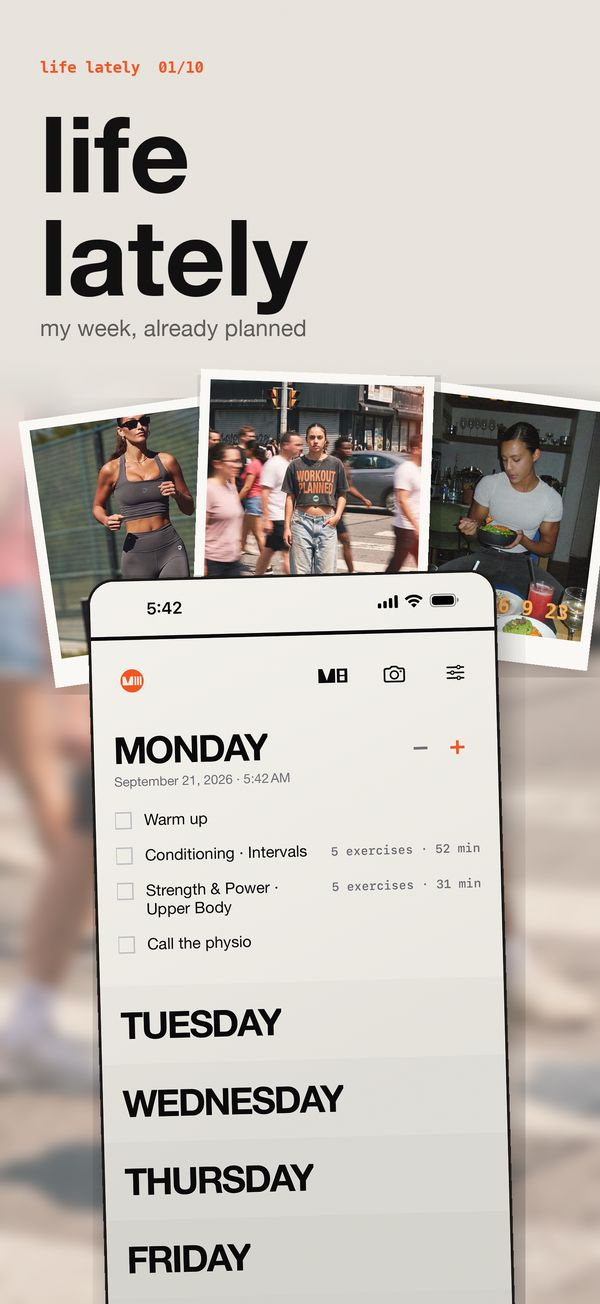
life lately · my week, already planned
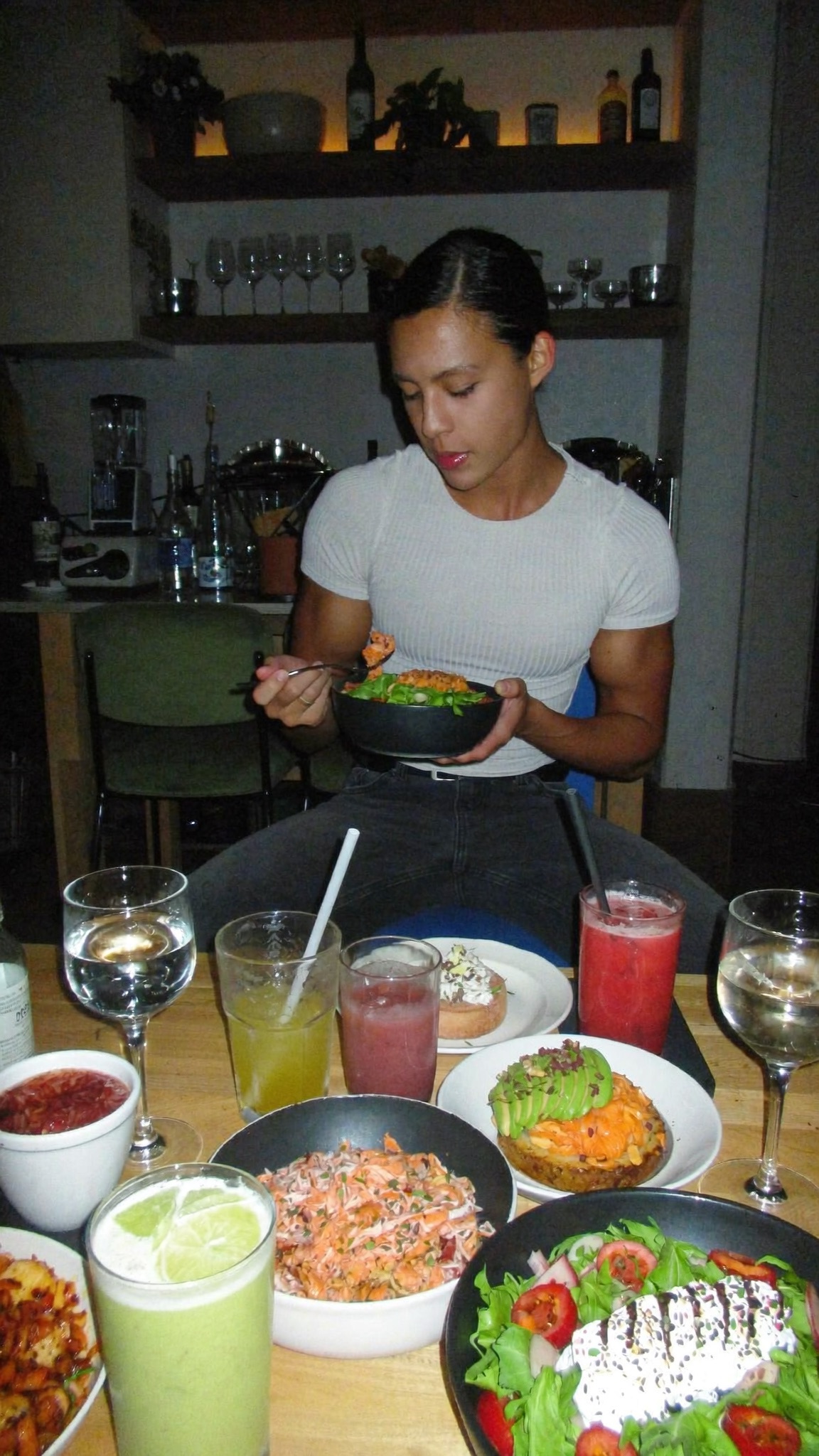
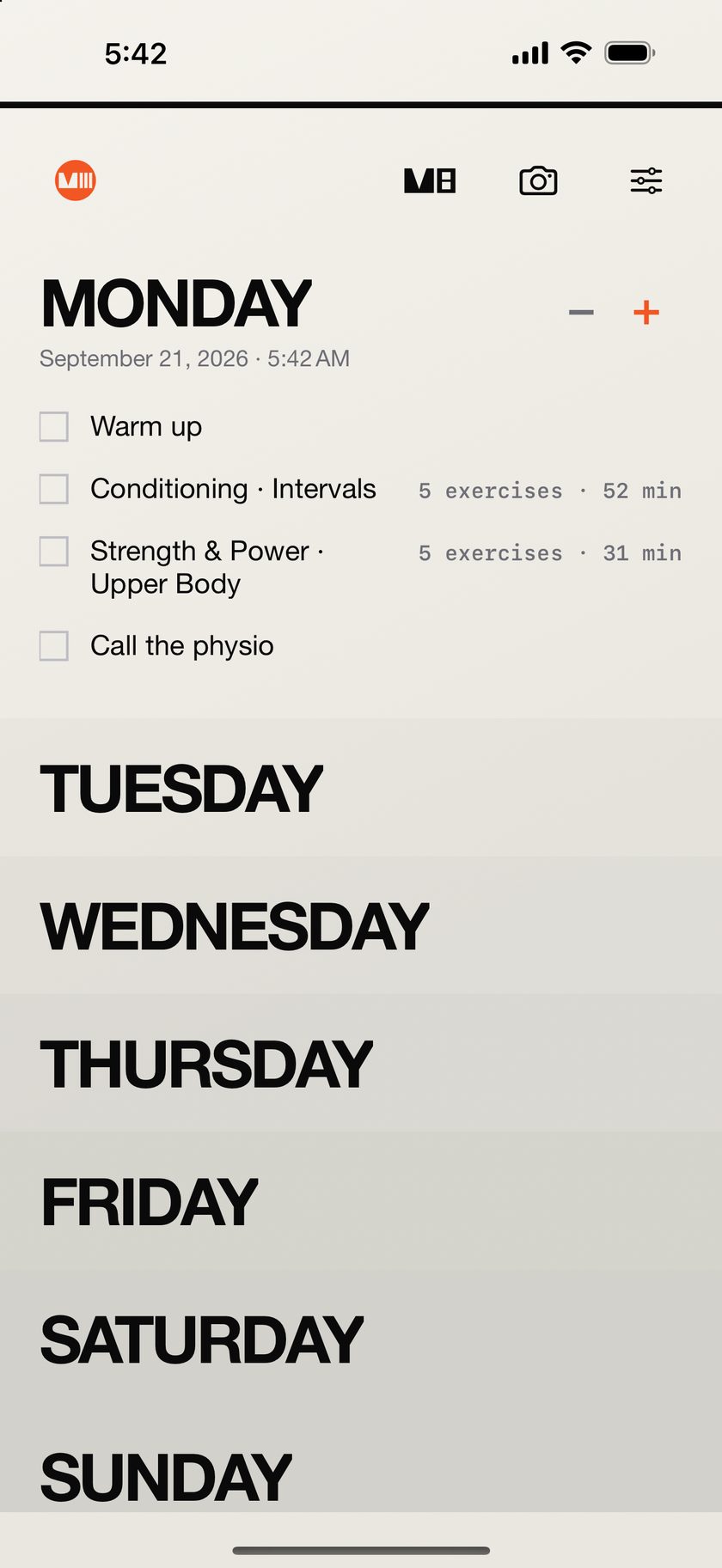
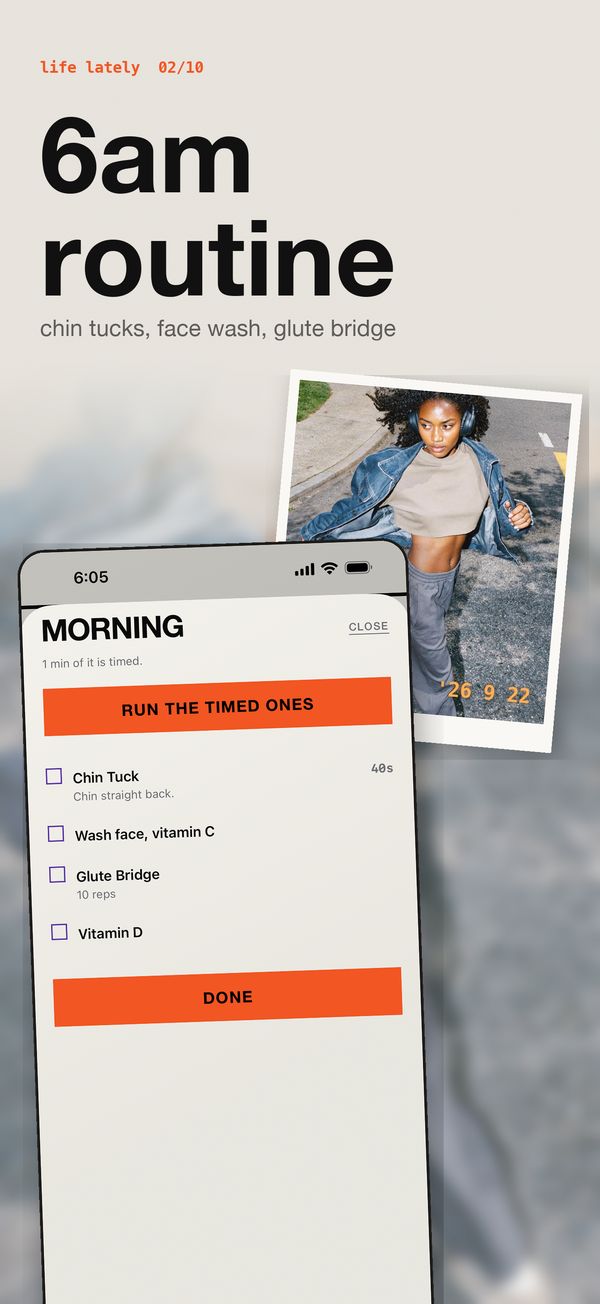
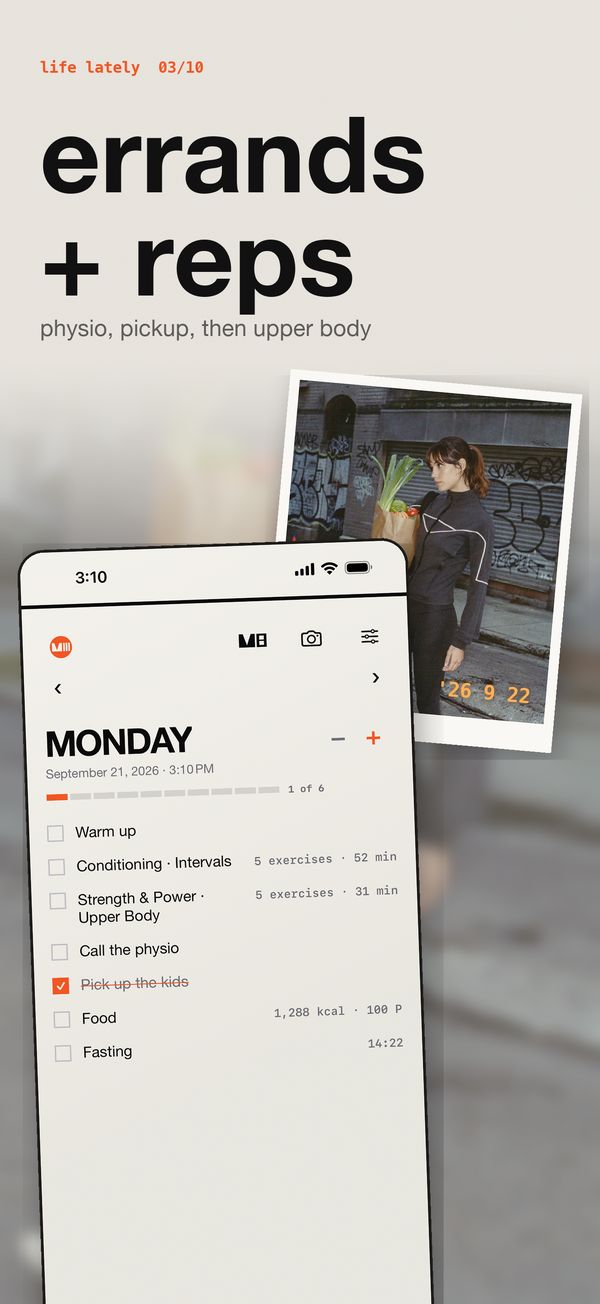
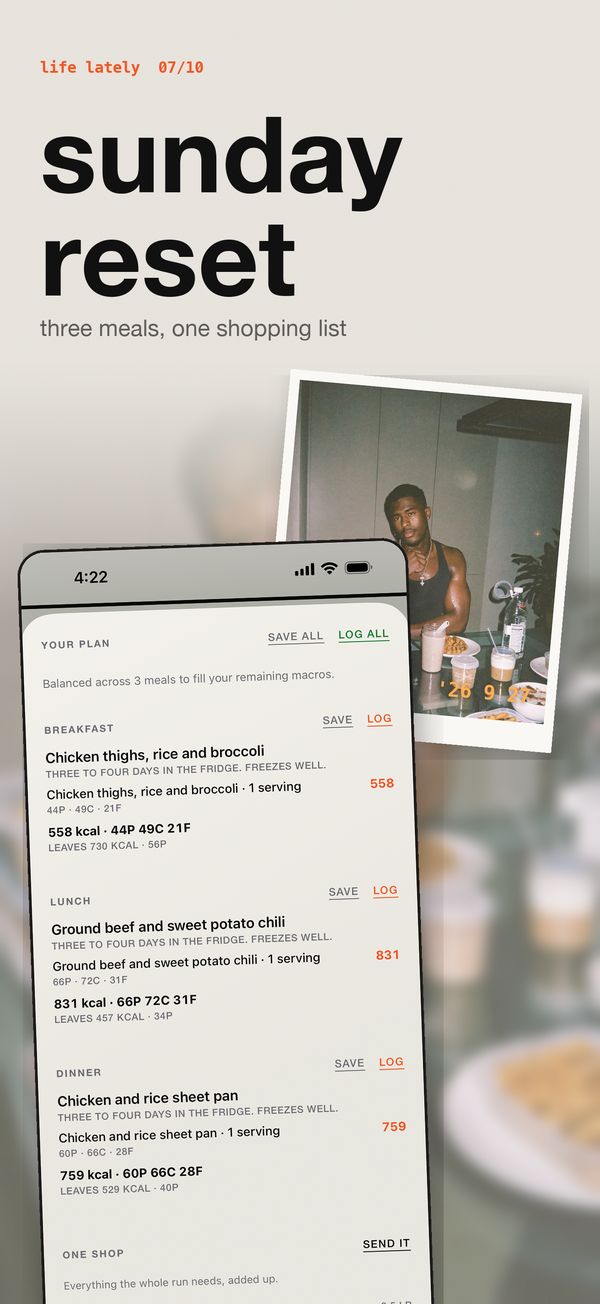
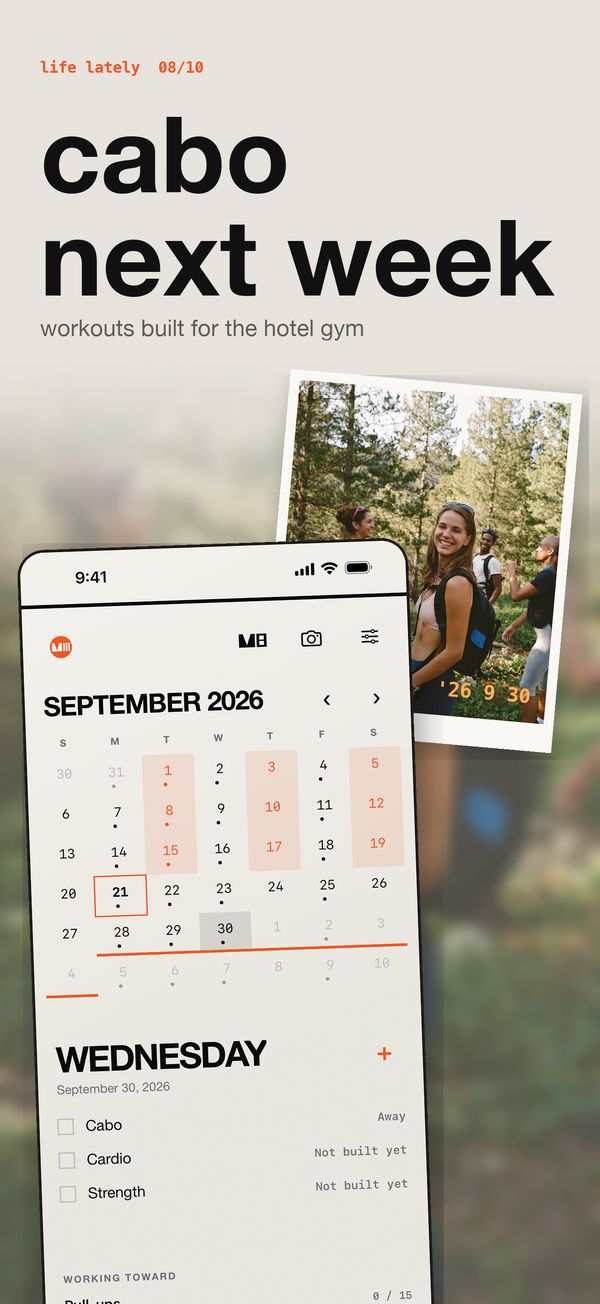
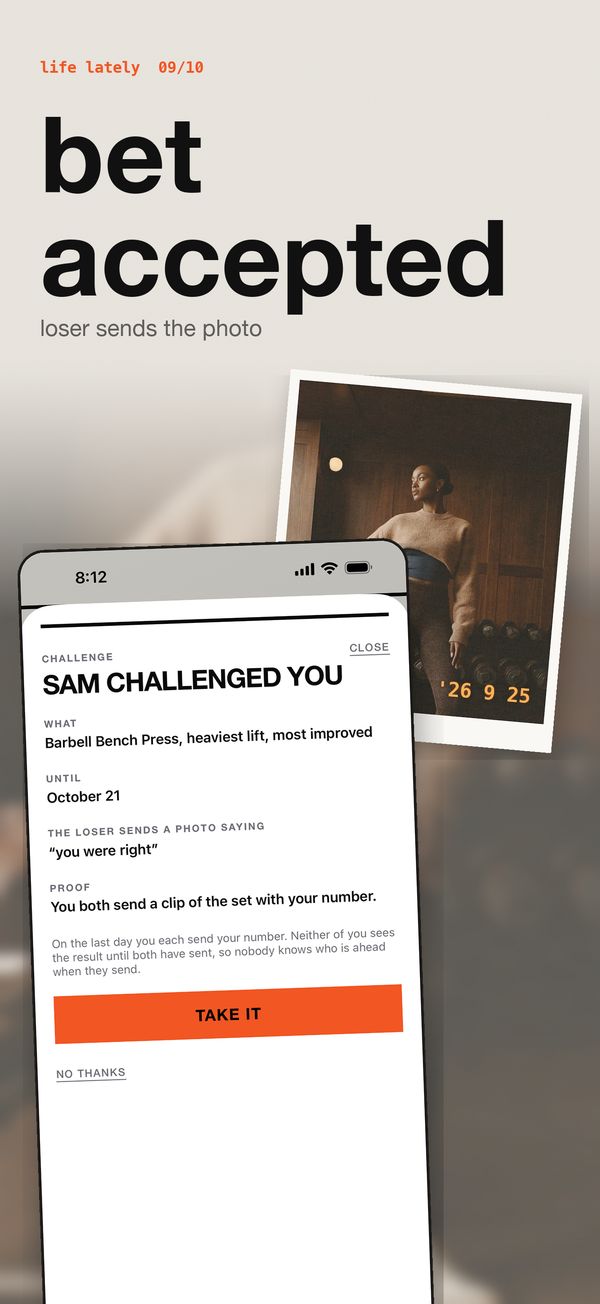
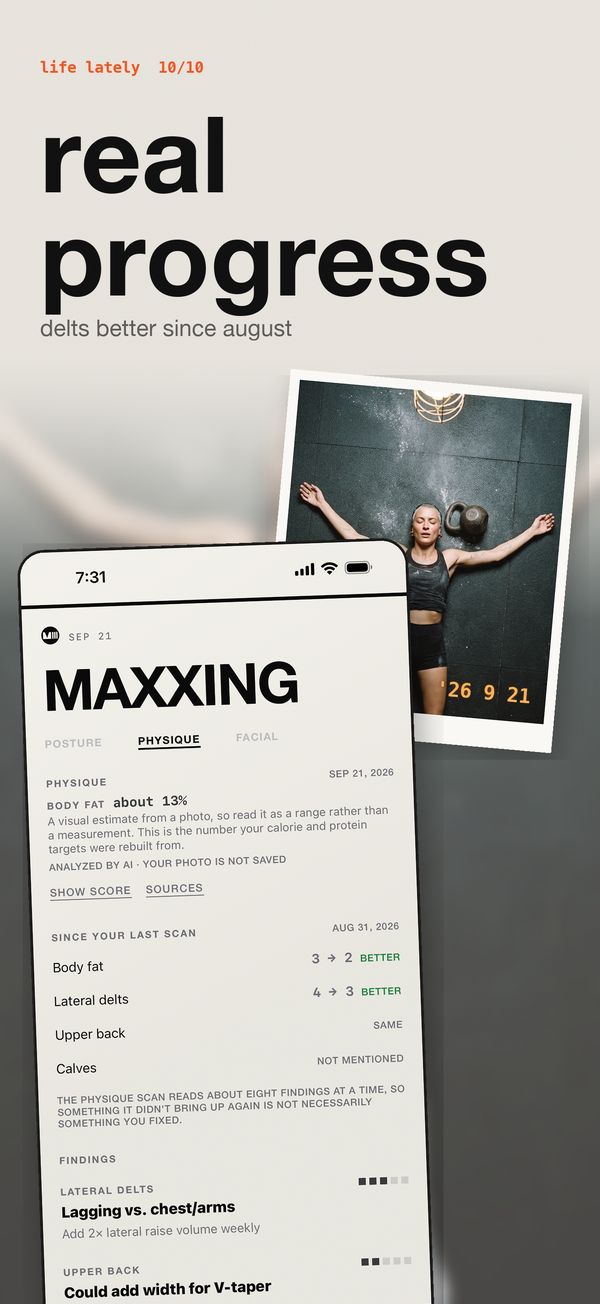
6am routine. errands + reps. asked coach 8. lunch out. gym date. sunday reset. cabo next week. bet accepted. The training, the food, and everything else on the day, on one list.

Or see today's workout, free · use it in your browser · join the Android beta
Free is a full training app: a workout every day, the food log, the fasting timer. No card, no clock. Pro is $14.99/month. No ads, no data sale, no catch. On either tier.
swipe the week →
Who it is not for. Anyone who wants follow-along video classes, a streak to protect, or a feed to post in. MVIII has none of them, on purpose.

Train with someone · Pro
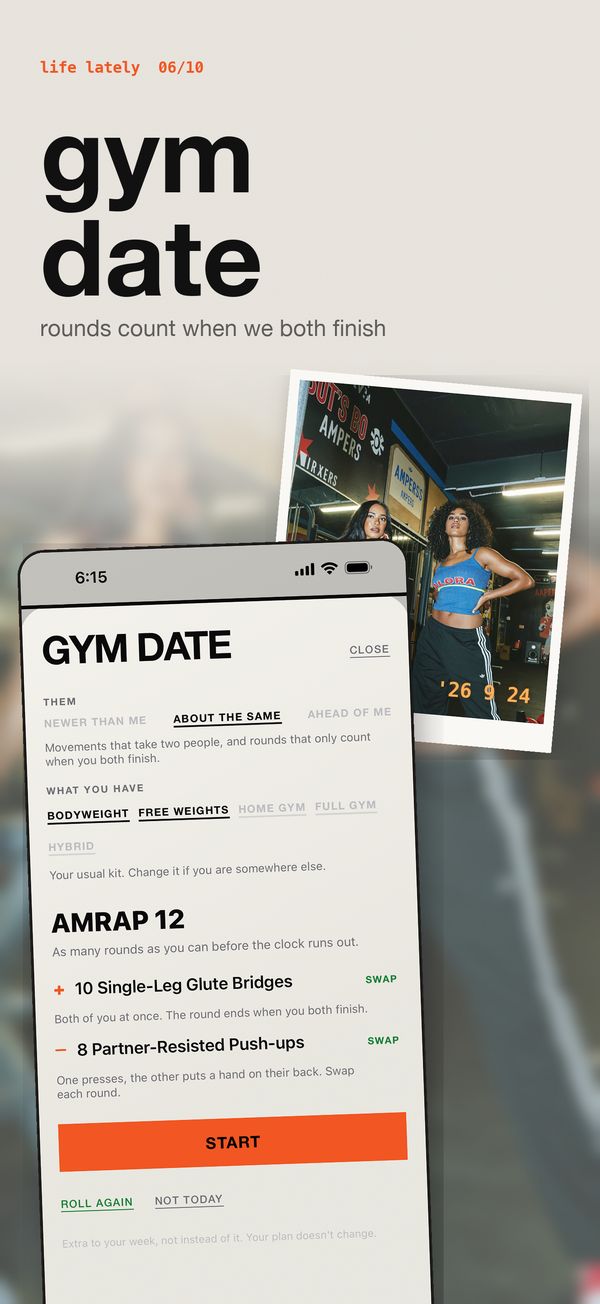
A Gym Date is built from movements that take two people. Passing a ball, holding a plank facing each other, rowing against someone’s weight. The round only counts when you both finish, and that is not a flourish. The effort people gain from training together shows up when the result depends on the slower of them, and not when two people simply work side by side.
With a friend is the other shape. One set of kit between you, taken in turns, where their work is your rest.
Say whether they are newer than you, about the same, or ahead. The session carries both your numbers, scaled so neither of you is coasting or drowning. Nothing is kept about them. They never install anything.
Put it on a Friday and it is there every Friday, and it rolls a new one each time.
Today, on this website
One full workout, every day, free, right here. Warm-up. The session. Sets, reps, rest, the pace to move at. Form cues on every movement. A cool-down. No account, no email, no app.
Everyone gets the same session. It needs a pair of dumbbells and a floor. No chatbot wrote it. The app’s own programming did, and that is the part you are really deciding about.
The week is the app
There is no tab bar. There is a week. Today opens, the rest stack below it, and everything that belongs to a day sits on that day: the session, what is left to eat, a fast if you are running one, and whatever you wrote down yourself.
Add anything
A custom task, a walk, an AMRAP or an EMOM, a warm-up, a scan, a dinner out, or a week away. Put an hour on it and it reminds you at the hour. Sync it to your calendar and it goes both ways.
Swipe left for the month, right for the day, your food, then what the week has trained. Choose in Settings which one opens when you unlock your phone, because everybody’s first screen is a different screen.

Coach 8
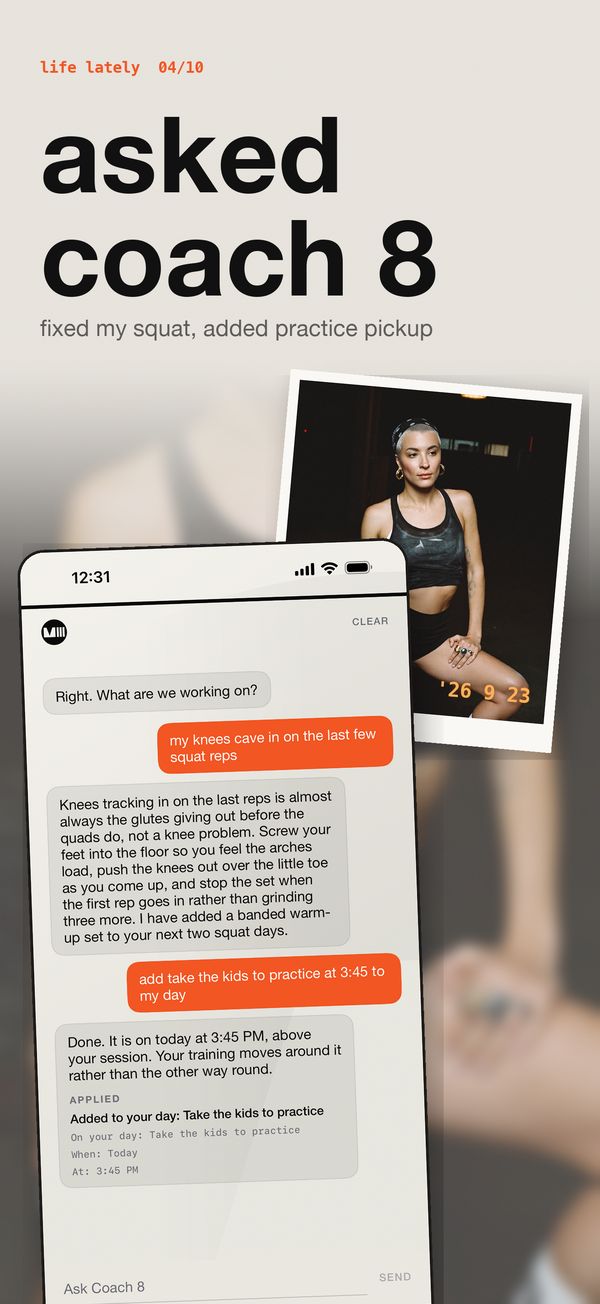
In one conversation: why your knees cave on the last rep, and a cue you can use on the next set. Then put the school run on today at five, and it goes on your day with a reminder on it.
It can log what you ate from a sentence, change which days you train, and take you to any screen in the app. Every other coach in this category explains. This one does the thing.
Ask it what to eat and it answers from the same research the programming comes from, names the study and how strong it is, and suggests what fits the calories and protein you have left. Ask it something the research does not cover and it says so.

Going away
Every session inside that range gets rebuilt for that kit, including the ones already written before you booked. The trip draws across the month as a run of days, so you can see the shape of the week rather than trust that it saved.

Programmed for
Pick the goal and the programming changes underneath you: the movements, the rep ranges, the rest, the conditioning, and what a hard day is even measured in. It is not a filter applied to one generic template.
Carry, ruck, endure. Work capacity, not a pump.
Conditioning first. EMOMs and intervals, not a lifting session with cardio bolted on.
And the physique scan tells it where you are behind.
Good at everything, useless at nothing.
Lifting that serves the run rather than competing with it.
A prop and a winger do not need the same week.
Tactical
Prescribing "400m" assumes a measured route. No one training in a garage, a hotel corridor or a stairwell has one, so the same number meant four different efforts to four different people. Carries run on a clock instead. Load records, distance records if you happen to know it, and two carries at the same weight for the same time rank by the ground you covered.
Rucks, farmer's walks, sled work and drags are programmed as their own thing, not as a plank with a different name.

HIIT
Choose HIIT and the week is built around intervals: EMOMs, work-to-rest that means something, and sessions measured in minutes rather than sets. Your macros move with it, because a conditioning day and a heavy day do not want the same carbohydrate.
The hard days are short on purpose. A six minute EMOM you actually finish beats a forty minute session you talk yourself out of.

Suggest
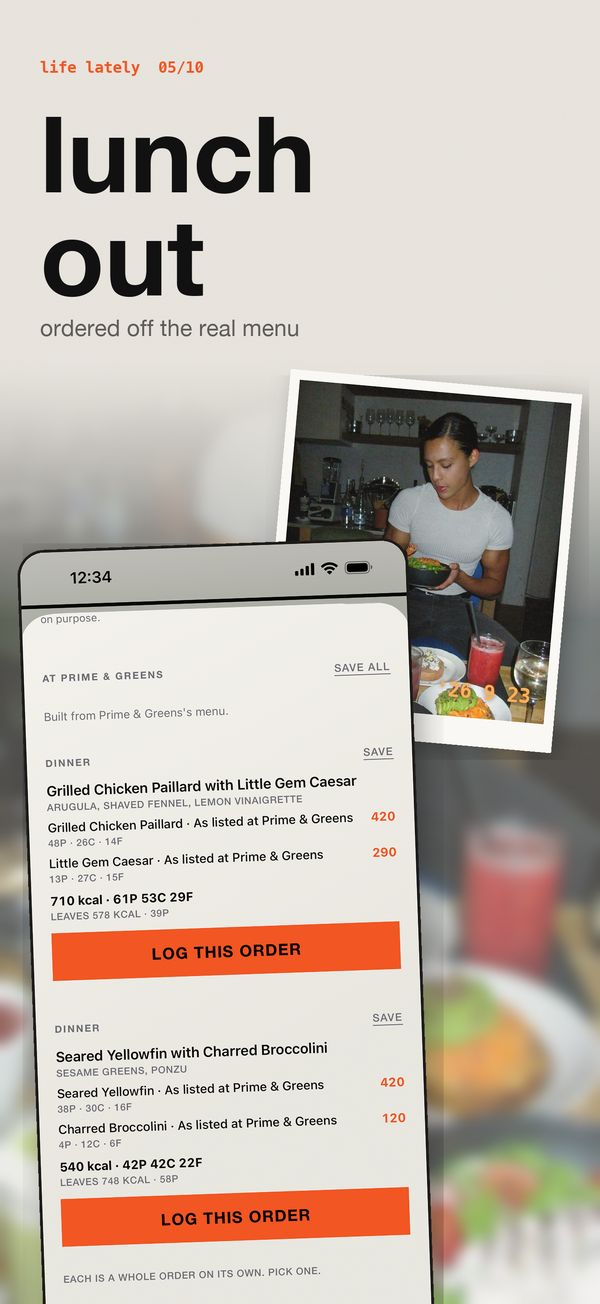
Logging tells you what you already ate. Planning tells you what to eat, before you decide. Four ways in, all built on the foods you actually like and the ones you cannot stand: a day of meals against what you have left, a batch cook for the week, a no-cook snack list, and an order written off a real restaurant menu.

Cookbook · recipes free, the full library with Pro
Real dishes with a method you can follow, a shopping list, and macros worked out from the weights rather than estimated. Salt, fat, acid and heat, held to the principles chefs actually learn from, which is why none of it is a chicken and broccoli bowl.
Write your own in too.

The reason people quit tracking is having a life.
This is the tracker that survives one.
Set your inputs once: meals per day, macro split, food pattern, the things you'll never eat again. Suggest builds around them. Vegan or carnivore, it doesn't care and it doesn't comment.
Dine Out
Not a database of chain nutrition facts. The real menu, found online or read from a photo of the one in your hands, then turned into an order that lands on the macros you have left. It tells you what to ask for, what each dish costs you, and what the meal leaves for the rest of the day.
Every dish is priced against what is actually left, so the answer changes depending on whether you trained this morning. Say it is a cheat day and it stops pretending otherwise, and orders what you actually want.
If you have a table booked, MVIII can have the order ready before you sit down. A calendar event is matched on your phone, never sent to a model, and it asks you before it goes anywhere near the menu.

While you train
On the first exercise, MVIII asks one question: do you want your food sorted by the time you finish? A day of meals, a cook-once prep, or an order at a restaurant. Answer it, put the phone down, and train.
The timing is the whole idea. Reading a real menu takes a minute or two, and a session is the one stretch where your phone is already out and you are not waiting on it. So the minute goes there, instead of you standing in the doorway of the restaurant thumbing at a screen.
It also gets the numbers right. The order is written for the macros the session you are doing right now is about to earn you, not the ones you had sitting still. Finish the last set and it is on your summary, next to the cool-down.
You are asked once, on the first exercise, and never again that session. It is a question while you are standing still reading the screen anyway, not a notification an hour later.

And when you rack the last set
The summary is not a scoreboard. It is a cool-down built from what you just trained, your food already waiting where you left it, and what the session earned you: on this day, 188 calories over an average one, mostly as carbohydrate. Protein does not move, on any day.
One question at the end, how hard was that, and it tunes the next session. That is the only thing MVIII asks you to score.

Targets
Every formula for daily calories is a population average with a wide error bar around it. So MVIII stops trusting the formula. It compares what you have actually eaten against what you have actually weighed, and corrects your maintenance from your own numbers.
It also stops pretending a heavy Monday and a rest-day Tuesday are the same. Hard days get more carbohydrate, rest days get less, and the week adds up to the same total. Protein does not move, on any day, because what builds muscle is the daily total rather than the timing.
What it will never do is add your workout's calorie burn back on top. Your target already contains your training, so counting the session again is how people quietly undo their own deficit. The evidence


Stack · GLP-1, peptides, hormones, meds, supplements
Log a weekly shot, or anything else you take, under your own name for it. It sits on your day at the time you usually take it. One tap logs it.
Ask, and MVIII lines up your own logs against the days since each dose. Calories and protein for day 0 through day 6, the middle value across every week you have logged. Your first weeks next to your recent ones. Weight, training and your top sets, before and since. Lean and fat mass too, if your scale measures them.
It will not tell you what to take, when, or how much. It never says what a medication did. Log more than one thing and it says so first, because your numbers may mirror all of them. What you make of it is between you and your clinician. Protein on a GLP-1
Stack stays on your phone and is never sent to us. Part of Pro.

From the App Store
“I also love the postpartum workouts—they've been so helpful during my recovery.”
Price
Free is fifteen lines long and none of them are a teaser. Pro is $14.99 a month. Read the first line of the replacement table below: that is the workout generator on its own, at $15.99. MVIII costs less than the one app it replaces, and it replaces five.
Less than Fitbod alone.
Less than Fitbod alone. Less than an eighth of the running total above it. One app, one dataset, one bill.
And not one of them can read your remaining macros and write your order off the menu of the restaurant you're standing outside.
Fitbod, MacroFactor, Zero and Eat This Much checked September 2026 against each vendor's own page, and Eat This Much publishes no monthly rate, so the table carries its annual one. PostureScreen and Umax are as listed July 2026. All of it is subject to change, so check it yourself instead of taking our word for it. And to be straight with you: a phone camera is not a DEXA scanner, and we won't pretend otherwise. Those lines are what the assessment category costs when it isn't on your phone, not a claim of clinical equivalence. What MVIII does is put a usable version of both in your pocket and wire the results into the workout you do on Thursday.
The free app is real, and it's yours forever. A workout every day on seven goals with progression and deloads, your whole week and month with your own calendar beside it, anything you write down yourself, every conditioning format, walks and runs, the food log with no cutoff, recipes and your own, fasting, challenges and bets with a friend, the watch app, and the body contexts. No card, no clock. Pro adds Coach 8, the scans and the sessions built from them, your week planned hour by hour, the Sport, Hybrid and VO2 Max goals, a week away, meal planning, the full recipe library, eating out, Stack, and a workout for two people or a whole room.
Two weeks, money back. Email refund@mviiiwod.com within two weeks of your first charge. We'll get your refund through Apple, no questions asked.
Cancel in two taps. Settings · Subscriptions · Cancel.
Email answered same day. mviii@mviiiwod.com.
Nothing is locked in. One month at a time.
One system
Bundling is easy. Bundling where the parts talk to each other is the hard part, and it's the reason a single app can beat three good ones.

Thursday's session changes to target it. You didn't file a request.
Dinner gets written to fit, off the menu of the restaurant you're standing outside.
Your carbs move to meet it. Three separate apps cannot do this at all.
Everything else
The session, the errands you wrote down, and the hours you put on them, on the watch. A Start button under it, and the movements under that for checking between sets.
Programmed to your goal, your equipment, your injuries, and a real time budget. Swap any day. Regenerate the lot.
Barcode scan, photo estimate, water. Protein, carbs, and fat on one sharp screen.
Every set you log builds a training record: your movements, your loads, and a PR line for each one. Weight, body fat, and posture over time. Two-way Apple Health sync.
Standard, 16:8, or OMAD. The timer runs your window and tells you when you can eat.
A nudge on training days at the time you pick, and rest days stay quiet. A ping when your fast completes, a warning before the window closes. All on-device, all free.
Scan · behind the camera mark
Point the camera. Everything is measured on-device, compared against your own last scan and never against anyone else, and every finding leaves as something to do, not as a rank.
Desks did this to most of us. Findings go straight into the mobility work in your next session.
Calves behind quads and hamstrings? Thursday's WOD picks it up. Symmetry against your own last scan, not a leaderboard.
Facial exercises to improve symmetry, plus the habits a training week actually moves. No surgery talk, ever. No attractiveness number. That isn't a measurement, and you can't train it.
Face blurred on-device. Scans analyzed, then deleted. Never stored, never used to train anything.


The name
It is a Roman numeral doing two jobs at once, which is the whole idea of the app in one word.
M
The Roman thousand. The long haul, the part no one sees, counted in days rather than sessions.
VIII
Today's work. Eight movements, once. The only number you are ever asked to think about.
1008
A thousand days, eight at a time. The commitment and the ask, in the same word.
Eight daily movements is where we started. We meet people where they are, though, so some days ask for more and some for less.
Private by design
Facial scans are irreversibly pixelated by Apple Vision before anything leaves your phone.
Scan and meal photos are analyzed, then immediately discarded. They are never stored. Only the findings come back.
No trackers, no ad networks, no third-party analytics. Not one. Check the App Store privacy label yourself.
No passwords, no email lists. Your data sits behind per-user row-level security.

May you find purpose, and live there. May you find freedom, protect it; it has a habit of escaping. May you find peace, and make it your neighbor. May you find laughter, and make it your best friend.
But when you meet sorrow, be sure to find compassion. And when you stumble onto happiness, check the time. Memory will want a record.
When you see anger, run to understanding. But if it chases you, don’t be afraid to turn and meet it. Courage has a way of stepping in.
When loneliness comes, ask if it’s on a mission, and hope that support shows up. And if it doesn’t, remember, support is you.
MVIII · October 2026
Dark patterns
Not one of them is here, and not one was removed to get ahead of a rule
The tricks that keep people inside an app have stopped being a design debate and started being a liability. Three of the four things below are already law somewhere. The fourth is being drafted.
No streak to break, no counter to protect, no notification implying you have lost something. The one mechanic whose entire power is the fear of breaking it is the one mechanic we refuse to ship.
In September 2025 the FTC took $2.5 billion from Amazon over a Prime cancellation flow built to be hard. Ours is the App Store’s own, and we add nothing to it: no retention offer, no survey, no second screen.
Article 25 of the EU Digital Services Act bans designing an interface that deceives or manipulates a user out of a free choice. It binds online platforms rather than an app like this one. We are built as though it bound everyone.
The EU’s Digital Fairness Act, proposal due in the last quarter of 2026, is aimed squarely at addictive design and dark patterns. We have read the consultation. There is nothing in MVIII we would have to change.
Nothing here is built to keep you in it
Same argument the rest of this app makes, pointed at your attention instead of your evening. It gets you into the gym. Then it lets you go.
Library
Ninety-six of every hundred people who download a fitness app are gone in thirty days. Almost everyone who starts logging food stops. Not because they were lazy. Not because they picked the wrong app.
So we went and read the research on why. Not the blogs. The studies. Every figure below is attributed and dated, and where the evidence is thin we say so out loud.
Your appetite got smaller. Your protein requirement did not.
What actually changes, what does not, and which claims have nothing behind them.
A floor, not a ceiling. How to hit your protein when your appetite is small.
The first few sets do most of the work, and cutting rest is the wrong saving.
73% of people who quit food tracking said it took too long. 12% said it cost too much.
We went looking for evidence that choosing drains you. It failed two large replications.
MVIII for iPhone
Free is a full app, yours forever. Pro is $14.99/month, canceled in two taps.
Now on iPhone
The full training app is free: daily workouts, food log, fasting. Pro is $14.99/month for a more custom approach, less than the workout app it replaces.