References
The research MVIII programs from
MVIII programs against written evidence specifications rather than a house style. Twelve of them, covering what the app prescribes, how it talks to you, how it structures your week, where it tells you to put your attention, and what it will not claim. All twelve are published here in full: every prescription, the studies behind it, the grade of that evidence, and an explicit account of what the research does not support.
230 peer-reviewed citations between them. Meta-analyses, systematic reviews and position stands where they exist; controlled trials where they do not; nothing from forums, coaching sites or magazines. Every citation was retrieved and its abstract read on the date its document states.
What do the grades A, B and C mean?
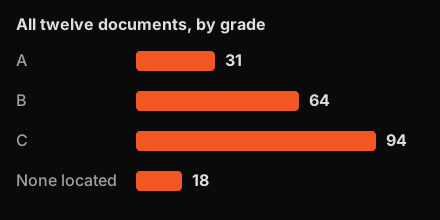
A means multiple meta-analyses or systematic reviews agree. B means one meta-analysis, or several consistent controlled trials. C means limited or single trials, wide intervals, high heterogeneity, or cross-sectional, retrospective, biomechanical or survey designs only.
A dash means no systematic review or controlled trial was located. That is a real gap, stated instead of filled in.
Four things are worth saying before you open any of them.
The grades are not uniform, and the documents say so themselves. The programming and protein entries rest on randomized-trial meta-analyses. The technique entries are acute biomechanics: they describe how a movement shifts mechanical demand, not that it produces more muscle over a year. The injury entries are retrospective epidemiology. A grade C row is the best available evidence, not an established fact, and the pages mark every one.
Not every document is a training document. Five of these are about the parts of MVIII that are usually left unexamined: the psychology under how the coach speaks, the behavioral structure under the schedule, the attentional research under the cues, the physiology under the stillness sessions, and what is actually known about skin after a large weight loss. They are held to the same standard as the training files, which means several of them mostly report how weak their own field is.
The progression document is the weakest, and it says so at the top. Progressions toward a first pull-up or a target pace have force-plate measurements of how heavy each step is, and no trial has ever compared one step order against another. Two of the numbers MVIII prescribes there have nothing published behind them at all. Both are graded as having none and both are printed, because a number the app programs from with no evidence should be visible rather than missing from the table.
Each document publishes what it refuses to prescribe. Optimal calorie surpluses, maximum recoverable volume, return-to-training protocols after injury, meet-day nutrition, sex-specific programming, that a wide grip works your lats harder, that it takes 66 days to form a habit, that shame motivates anybody, that meditation beats exercise for stress. These are things widely prescribed with confidence that the research does not currently support, and MVIII programs none of them. That list is the most useful part of every file.
Eighteen rows across these documents are graded as having no evidence at all, and most of them are things MVIII does anyway. The tone the coach speaks in. The absence of streaks. How long a stillness session should run. Whether a cue read off a phone works the way a coach saying it works.
Each was searched for specifically and each came back empty. They are printed rather than quietly rounded up, because a decision the app makes with nothing behind it should be visible as a decision.
Bodybuilding programming
Hypertrophy: weekly volume per muscle, training frequency, load and rep ranges, proximity to failure, rest, range of motion, exercise variation, and the nutrition that supports it. 47 sources.
Powerlifting programming
Maximal strength: intensity, per-lift frequency, specificity and variation, autoregulation, periodization, and the tapering and peaking evidence for a competition. 49 sources.
Skill & distance progression
The path to a first pull-up, a dip, a rep count, a run distance or a target pace. What each step was measured to load as a share of bodyweight, why negatives sit late, and why the ten percent rule does not do what it is famous for. 11 sources.
General, endurance and power
Running, HIIT, sport, tactical, functional and aesthetics: cardiorespiratory volume, intensity distribution, interval work, the strength base under power and occupational tasks, plyometric dose and mixed-modal injury epidemiology. 32 sources.
Conditioning and work capacity
Timed work intervals with a counted rep total: what the format is evidenced to do, what that rep count can honestly be compared against week to week, and why interval work is not the answer to fat loss that it is usually assumed to be. 6 sources.
Nutrition
Why a weight of food and a number of calories come apart, what the trials say about whether the diet you pick actually matters, how long a cooked meal really keeps, and where MVIII's own numbers are not connected to any of it. 13 sources.
Skin after weight loss
What loose skin actually is once the weight is off, what MVIII changes when you list it, and why almost everything sold to tighten it has never been tested on anyone who has lost a large amount of weight. 10 sources.
What actually shows up in the mirror
Sleep, food and training change how a face reads to other people, and the change is measurable within weeks. Includes the one finding MVIII refuses to act on: the level of facial fat rated most attractive is not the level rated healthiest. 8 sources.
Self-image and behavior change
The psychology under how Coach 8 talks to you. What raises somebody's belief that they can train, what damages it, why the app never comments on your body in either direction, and the three choices MVIII makes with nothing published behind them. 17 sources.
Systems, planning and maintenance
How the week is structured rather than how it is described. Planning, make-up sessions, progress monitoring, context consistency, and what the habit research says once you read past the slogan. The real figure is 18 to 254 days, not 66. 11 sources.
Muscle engagement and focus
Where to put your attention during a set, and why the answer changes with your goal and the job of the set. Includes why a wide-grip pulldown does not work your lats harder, and why almost every "best exercise for X" claim rests on a measurement error. 16 sources.
Stillness
What slow breathing measurably does, what meditation programs have and have not been shown to do, and why MVIII claims the first and not the second. Includes the finding that meditation has never been shown to beat exercise. 6 sources.
If you want the short version of how these turn into a training week, and where MVIII deliberately stops short of what the research would allow, that is written up in the library.
General fitness and wellness information, not medical advice. Nothing here substitutes for assessment by a qualified clinician. Consult your healthcare provider before changing your diet or exercise.