References · general
General, endurance and power: the evidence
MVIII's running, HIIT and power programming is less evidenced than its strength work. The cardiorespiratory and injury entries rest on a position stand and meta-analyses of randomised trials, and grade A. The interval, power and occupational entries come from narrative reviews and grade B or C. They set a direction, not a number.
How much of the running and HIIT programming is graded A?
The cardiorespiratory and injury entries are, on a position stand and meta-analyses of randomised trials. Interval structure, power and occupational entries come from narrative reviews and grade B or C.
Entries by grade: A 8, B 16, C 7. What the grades mean.
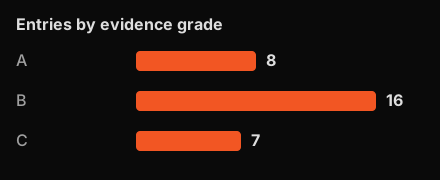
This document is thinner than the bodybuilding and powerlifting specifications and says so plainly. The cardiorespiratory and injury entries rest on a position stand and on randomised-trial meta-analyses and grade A. The interval-structure, power and occupational entries are narrative reviews and grade B or C: they establish direction, not a number.
Effect sizes are quoted only where the record was read at the date above. Entries that state a Finding: without numbers are cited for what they establish, not for a figure this document has put in their mouth. That is a deliberate limit, not an omission.
The entries
GT-P-01Weekly cardiorespiratory volume
Prescription≥30 min·d on ≥5 d·wk of moderate-intensity work, totalling ≥150 min·wk; or ≥20 min·d on ≥3 d·wk of vigorous work, totalling ≥75 min·wk; or a combination reaching ≥500–1000 MET·min·wk.
Evidence gradeA
EffectStated as a graded recommendation in an American College of Sports Medicine position stand covering apparently healthy adults of all ages [1].
PopulationApparently healthy adults; may extend to some chronic disease and disability when medically evaluated.
Sources[1]
CaveatsThe position stand is explicit that adults unable or unwilling to reach these targets still benefit from less than the recommended amount. MVIII treats these as a floor to build toward, not a gate.
GT-P-02Resistance, neuromotor and flexibility frequency
PrescriptionResistance exercise for each major muscle group on 2–3 d·wk. Neuromotor work involving balance, agility and coordination on 2–3 d·wk. Flexibility work for each major muscle-tendon group on ≥2 d·wk, 60 s total per exercise.
Evidence gradeA
EffectStated as a graded recommendation in the same position stand [1].
PopulationApparently healthy adults of all ages.
Sources[1]
GT-P-03Endurance intensity distribution
PrescriptionRoughly 75–80% of endurance volume at low intensity, under 10% at threshold, and 15–20% at high intensity.
Evidence gradeA
EffectPolarized distribution favoured for VO2peak, SMD 0.24 (95% CI 0.01–0.48, p = 0.040). The advantage was confined to interventions under 12 weeks (SMD 0.40, 95% CI 0.08–0.71) and to highly trained or national-level athletes (SMD 0.46, 95% CI 0.10–0.82). All outcomes were graded high certainty [2].
PopulationTrained and highly trained endurance athletes.
Sources[2]
CaveatsThe advantage did not extend to time-trial performance (SMD −0.01), time to exhaustion (SMD 0.30) or velocity and power at the second threshold (SMD 0.04). Polarizing distribution is supported for raising VO2peak and is not established as a way to race faster.
GT-P-04Interval work for aerobic capacity
PrescriptionWhere raising VO2max is the goal, interval work is the higher-yield tool.
Evidence gradeB
EffectAgainst no-exercise controls, high-intensity interval training raised VO2max by 5.5 mL·kg⁻¹·min⁻¹ and continuous endurance training by 4.9. Interval training beat continuous training by 1.2 mL·kg⁻¹·min⁻¹ (±0.9) [3]. (Corrected 2026-09-23: this line previously read 4.9 against 1.9, which the abstract does not say.)
PopulationControlled trials in healthy participants.
Sources[3]
GT-P-05Interval structure
FindingPrescribing an interval session is a multi-variable problem: work duration and intensity, relief duration and intensity, series length, between-series recovery, and the exercise modality itself all change which physiological system is loaded. There is no single correct protocol, and the target determines the combination.
Evidence gradeC
EffectNarrative synthesis across two companion reviews. No pooled effect estimate is offered by either, and none is claimed here [4][5].
GT-P-06Resistance training frequency
PrescriptionDistribute weekly resistance volume across at least two sessions per muscle group.
Evidence gradeB
EffectNon-volume-equated comparison favoured higher frequency, effect size 0.49 ± 0.08 against 0.30 ± 0.07 (p = 0.002) [6].
PopulationHealthy adults, trained and untrained.
Sources[6]
CaveatsThe same analysis could not generate reliable estimates once groups were matched for frequency per muscle group. Frequency is best read as a way of distributing volume rather than an independent driver.
GT-P-07Strength as the base under sport and power
FindingGreater maximal muscular strength underpins general and sport-specific task performance and improves force-time characteristics. Strength work is the prerequisite for power work rather than an alternative to it.
Evidence gradeB
Sources[7]
GT-P-08Developing maximal power
FindingMaximal neuromuscular power depends on both maximal force capacity and the rate at which force is developed, so a program targeting power needs heavy strength work and explosive work rather than either alone.
Evidence gradeB
Sources[8]
GT-P-09Concurrent training
FindingCombining endurance and resistance training attenuates strength, hypertrophy and power adaptations relative to resistance training alone, and the size of the interference tracks the frequency and duration of the endurance work and the modality used.
Evidence gradeB
Sources[9]
CaveatsThis is the reason MVIII asks whether a member wants cardio rather than adding it silently.
GT-P-10Progression
FindingProgression in resistance training is achieved by systematic variation of volume, intensity, frequency and exercise selection over time rather than by adding load alone.
Evidence gradeB
Sources[10]
GT-P-11Load carriage
FindingLoad carriage performance responds to resistance training, to aerobic training, and to carrying loads specifically, with combined programs performing best.
Evidence gradeB
Sources[11]
GT-P-12Occupational and military task performance
FindingEssential military task performance rests on both maximal strength and aerobic capacity, which makes concurrent training unavoidable in this population and task specificity important alongside it.
Evidence gradeC
Sources[12]
# PART B — Injury
GT-I-01Exercise to prevent injury
PrescriptionInclude strength training. It is the single most effective injury-prevention exposure identified.
Evidence gradeA
EffectAcross 25 trials, 26,610 participants and 3,464 injuries: strength training risk ratio 0.315 (95% CI 0.207–0.480); proprioception training 0.550 (0.347–0.869); multiple-exposure programmes 0.655 (0.520–0.826). Acute injuries were reduced (RR 0.647, 0.502–0.836) and so were overuse injuries (RR 0.527, 0.373–0.746) [13].
PopulationRandomised controlled trials in sport.
Sources[13]
GT-I-02Plyometric training evidence base
FindingThe plyometric jump training literature has been mapped in a scoping review of its methodology, which is the appropriate level of confidence to hold about it: the research base is broad and methodologically uneven.
Evidence gradeC
Sources[14]
# PART C — Sport qualities
The Sport goal is not one thing. A boxer needs speed, repeatable output and a conditioning base; a footballer needs acceleration, change of direction and strength. These entries are the qualities MVIII programs toward, and what the evidence says about training each of them.
GT-S-01Acceleration and sprint speed
PrescriptionTrain sprinting by sprinting. Where acceleration over the first 10 m is the target, resisted sprinting is the method with direct support.
Evidence gradeB
EffectAcross 21 studies, only resisted sprint training produced a significant improvement in 10 m acceleration compared with normal sprinting [15]. A separate meta-analysis of resisted sled training reports improvement in sprint performance and examines load magnitude [16].
PopulationTrained athletes across team sports.
CaveatsAcceleration and maximum velocity are trainable separately and respond to different distances. Improving one does not guarantee the other.
GT-S-02Change of direction and agility
PrescriptionProgram change of direction and reactive work separately from straight-line speed.
Evidence gradeB
EffectSpeed, agility and quickness training improved sprint performance, change of direction, reaction time, lower-limb power and flexibility across 11 randomised controlled trials in 499 athletes, with small to moderate effect sizes [17]. Change of direction speed and agility correlate only moderately, r = 0.46 across 21 studies and 945 team-sport participants [18].
PopulationAdolescent and adult team-sport athletes.
CaveatsThat r = 0.46 is the important number and the reason this entry exists. Change of direction is a planned movement and agility is a response to a stimulus. They share less than half their variance, so training one is not training the other, and a drill run to a cone is not an agility drill.
GT-S-03Repeated sprint ability
FindingRepeated sprint ability is the quality that separates a sport with recurring efforts from one with a single maximal effort, and strength training contributes to it rather than only to peak speed.
Evidence gradeB
Sources[19]
CaveatsThis is the quality a boxer and a footballer share and a powerlifter does not. It is trained by repeating efforts with incomplete recovery, which is why MVIII's conditioning work for the Sport goal is interval-shaped rather than continuous.
GT-S-04Strength for endurance performance
PrescriptionDistance athletes should lift. Strength work improves the physiological determinants of middle- and long-distance performance without the hypertrophy that would cost them.
Evidence gradeA
EffectSystematic review of strength training effects on the physiological determinants of middle- and long-distance running performance [20]. A later meta-analysis examines running economy across different running speeds and finds strength training programs improve it [21].
PopulationMiddle- and long-distance runners.
CaveatsThis is the entry most often ignored by distance runners and the reason MVIII programs resistance work under the Running goal rather than treating running as the whole program.
GT-S-05Monitoring load
FindingTraining load monitoring exists to make fatigue visible before it becomes a missed block, and both internal and external measures are used because neither alone describes the dose.
Evidence gradeC
Sources[22]
GT-S-06Load for running-economy strength work
PrescriptionHeavy. Near-maximal loads, at or above 90% of a one-rep max, produced the largest improvement in running economy.
Evidence gradeB
EffectTwenty-two articles compared heavy resistance training against plyometric training as an adjunct to running. Heavy resistance improved running economy (g = −0.32, 95% CI −0.55 to −0.10) where plyometric training was trivial (g = −0.13, 95% CI −0.47 to 0.21), and the same ordering held for time-trial performance (g = −0.24 against g = −0.17). Within the heavy-resistance arm, loads at or above 90% 1RM produced greater effects (g = −0.31) than lower loads [29].
Population216 long-distance runners across 13 heavy-resistance studies; 263 across 9 plyometric studies.
Sources[29]
CaveatsA threshold from a subgroup analysis, not a range. The paper reports that loads at or above 90% did better; it does not establish an upper bound, and no band should be read into it. This entry is also the reason MVIII's Running goal does not prescribe eight to twelve repetitions: that is a hypertrophy shape, and GT-S-04 is explicit that the strength a distance runner needs is the kind that arrives without the hypertrophy that would cost them. It does not follow that plyometrics are useless. Both arms improved both outcomes; heavy work simply improved them more, and GT-P-08 is the reason a power programme carries both rather than choosing.
GT-S-07Strength block length for running economy
Prescription10–14 weeks, default 12.
Evidence gradeB
EffectInterventions of 10 to 14 weeks produced a larger effect on running economy (g = −0.45) than those of 6 to 8 weeks. The average intervention across the heavy-resistance arm was 9.6 weeks, which is under the more effective window [29]. The same review found the plyometric arm averaged 6.9 weeks, with most studies running six weeks or shorter, and noted longer plyometric programmes did better too (8–10 weeks, g = −0.26, against 4–6 weeks, g = −0.06).
PopulationLong-distance runners.
Sources[29]
CaveatsThe 12-week default is a documented interpolation at the midpoint of the published window, not a figure the paper states. What the paper does state is the direction: most of this literature is too short, in both arms, and the studies that ran longer found more. MVIII's four-week block is shorter than any of this, which is a real mismatch and is recorded here rather than papered over: a member sees the effect across three blocks, not one.
GT-A-01Resistance training after 65
PrescriptionTrain. Resistance training is the intervention against strength loss, sarcopenia and frailty, and age is not a reason to withhold it.
Evidence gradeA
EffectPosition statement of the National Strength and Conditioning Association, concluding that resistance training is a powerful intervention against muscle strength loss, muscle mass loss, physiological vulnerability and their consequences for physical functioning, mobility, independence, chronic disease management, psychological well-being and quality of life [30].
PopulationOlder adults.
Sources[30]
CaveatsThe entry says train, not train differently. What changes with age is the dose, and that is GT-A-02, not the permission.
GT-A-02Dose for strength after 65
Prescription2–3 sets, 7–9 repetitions, 70–79% 1RM, 60 s between sets, two sessions a week.
Evidence gradeA
EffectMeta-analysis of 25 randomised controlled trials, 819 participants, mean age 70.4 years. Dose-response peaks for muscle strength: 2–3 sets (SMD 2.99), 7–9 repetitions (1.98), 70–79% 1RM (1.89), 60 s rest (4.68), two sessions per week (2.13), time under tension 6.0 s (3.61). The overall effect on strength was large (mean SMD 1.57) [31].
Population819 healthy older adults, mean age 70.4.
Sources[31]
CaveatsThe morphology arm of the same analysis peaks at a different rest (120 s) and a lower intensity (51–69% 1RM), so these are the strength numbers and not a single best programme. The rest figure is the surprise and worth reading twice: 60 s is SHORTER than this app gives a middle-aged member on the same movement, and it carries the largest effect size in the table. The strongest single variable is training period, 50–53 weeks, which is longer than any block this app runs.
GT-A-03Jumping after 65
FindingPlyometric training is feasible and safe in older adults, and no study reported an increase in injuries or other adverse events.
Evidence gradeB
EffectSystematic review of 12 studies, 289 participants (176 women, 113 men), mean ages 58.4 to 79.4, interventions of 4 weeks to 12 months, mean PEDro 6.0. Effects on muscular strength, jump performance and physical performance were consistently greater than in non-exercising controls [32].
PopulationCommunity-dwelling older adults.
Sources[32]
CaveatsThis entry exists to stop an assumption, not to license a dose. The design instinct is to take jumping away from older members, and the evidence does not support doing so: nothing was reported to go wrong across 289 people. What the review does not give is a dose, so GT-X-01's jump count is what MVIII programs and age does not change it. Participants were community-dwelling and screened, which says nothing about somebody a clinician has restricted; that is what a declared clearance is for.
# PART D — Plyometrics, bodyweight training and mixed-modal fitness
These three domains overlap heavily and each carries detail the others lack. Plyometrics has the best dose-response data of anything in this document. Bodyweight training has the best evidence on accessibility and on what goes wrong when it is done unsupervised at volume. Mixed-modal fitness, CrossFit and high-intensity functional training, has by far the best injury epidemiology, because it is the only one of the three that has been studied at scale as a population. Read across them rather than treating them as separate sports.
GT-X-01Plyometric dose for jump height
PrescriptionMore than 10 weeks and more than 20 sessions, at high intensity with more than 50 jumps per session. Combine jump types rather than repeating one.
Evidence gradeA
EffectMeta-analysis of 56 studies and 225 effect sizes. Training volumes over 10 weeks and over 20 sessions, using high-intensity programmes with more than 50 jumps per session, maximised the probability of significant improvement (p < 0.05). Combining squat jump, countermovement jump and drop jump beat using one form alone (p < 0.05). Athletes with more sport experience gained more (p < 0.01), and participants in good or poor condition benefited equally (p < 0.05) [23].
PopulationLower-limb plyometric programmes across trained and untrained participants.
Sources[23]
CaveatsThe same analysis found no extra benefit from adding external weight to plyometrics. Loading a jump is not a progression, it is a different exercise.
GT-X-02Plyometrics for sprint performance
FindingPlyometric training transfers to sprint performance, which is why it is programmed alongside sprinting rather than instead of it.
Evidence gradeB
Sources[24]
GT-X-03Unilateral against bilateral plyometrics
FindingUnilateral plyometric work favours single-leg jumping, acceleration and change of direction; bilateral work favours bilateral jump performance. The two are not interchangeable and the choice follows the demand of the sport.
Evidence gradeB
Sources[25]
CaveatsThis is the entry that matters for anybody whose sport happens on one leg at a time, which is most of them.
GT-X-04Plyometric evidence quality
FindingThe plyometric literature has been mapped in a scoping review of its own methodology, and it is broad and methodologically uneven. Hold the dose entries above with more confidence than any single protocol claim.
Evidence gradeC
Sources[14]
GT-X-05Bodyweight training as a real training stimulus
FindingBodyweight training produces measurable functional gains in populations that cannot use load, including frail older adults, using slow movement at low intensity.
Evidence gradeC
Sources[26]
CaveatsObservational rather than randomised. It establishes that the modality works without equipment, not that it matches loaded training.
GT-X-06Injury in app-directed bodyweight training
FindingAn international survey of 3,668 participants in app-based bodyweight training recorded injury incidence and the specific patterns it produces.
Evidence gradeC
Sources[27]
CaveatsSurvey data, self-reported. It is included because it is the closest evidence to what MVIII itself is: a phone directing bodyweight work without a coach in the room, and it is worth knowing what that produces.
GT-X-07Injury in mixed-modal fitness
PrescriptionProgram shoulder, spine and knee conservatively in mixed-modal work, and treat coaching supervision as a training variable rather than a nicety.
Evidence gradeB
EffectSystematic review of 25 studies and 12,079 practitioners. Mean injury prevalence 35.3%, incidence between 0.2 and 18.9 per 1000 hours of training. Most affected: shoulder 26%, spine 24%, knee 18%. Of the studies reporting it, a mean 8.7% of injuries required surgery. Reported risk factors were older age, male sex, higher body mass index, previous injury, lack of coach supervision, experience in the modality, and competing [28].
PopulationCrossFit practitioners internationally.
Sources[28]
CaveatsThe review concludes the injury rate is similar to weightlifting and powerlifting, which is the honest framing: mixed-modal training is not unusually dangerous, and the shoulder is its characteristic problem. MVIII carries this into movement selection rather than into a warning label.
Does stretching prevent injury?
No. The pooled risk ratio is 0.963, and its interval includes no effect at all. Stretching for injury is one of four general training claims MVIII does not program.
- That stretching prevents injury. Pooled risk ratio 0.963 (95% CI 0.846–1.095), which includes no effect [13].
- That polarizing your training makes you race faster. The advantage is specific to VO2peak and did not appear for time-trial performance, time to exhaustion, or velocity at threshold [2].
- That there is an optimal interval protocol. Neither companion review offers a pooled estimate, because the answer depends on which system is being targeted [4][5].
- That cardio can be added to a strength program for free. Interference is real and scales with endurance frequency and duration [9].
The 32 sources, checked 19 August 2026
- Garber CE, Blissmer B, Deschenes MR, Franklin BA, Lamonte MJ, Lee IM, Nieman DC, Swain DP. American College of Sports Medicine position stand. Quantity and quality of exercise for developing and maintaining cardiorespiratory, musculoskeletal, and neuromotor fitness in apparently healthy adults: guidance for prescribing exercise. Medicine & Science in Sports & Exercise. 2011;43(7):1334–1359. https://doi.org/10.1249/MSS.0b013e318213fefb
- Silva Oliveira P, Boppre G, Fonseca H. Comparison of polarized versus other types of endurance training intensity distribution on athletes' endurance performance: a systematic review with meta-analysis. Sports Medicine. 2024;54(8):2071–2095. https://doi.org/10.1007/s40279-024-02034-z
- Milanović Z, Sporiš G, Weston M. Effectiveness of high-intensity interval training (HIT) and continuous endurance training for VO2max improvements: a systematic review and meta-analysis of controlled trials. Sports Medicine. 2015;45(10):1469–1481. https://doi.org/10.1007/s40279-015-0365-0
- Buchheit M, Laursen PB. High-intensity interval training, solutions to the programming puzzle. Part I: cardiopulmonary emphasis. Sports Medicine. 2013;43(5):313–338. https://doi.org/10.1007/s40279-013-0029-x
- Buchheit M, Laursen PB. High-intensity interval training, solutions to the programming puzzle. Part II: anaerobic energy, neuromuscular load and practical applications. Sports Medicine. 2013;43(10):927–954. https://doi.org/10.1007/s40279-013-0066-5
- Schoenfeld BJ, Ogborn D, Krieger JW. Effects of resistance training frequency on measures of muscle hypertrophy: a systematic review and meta-analysis. Sports Medicine. 2016;46(11):1689–1697. https://doi.org/10.1007/s40279-016-0543-8
- Suchomel TJ, Nimphius S, Stone MH. The importance of muscular strength in athletic performance. Sports Medicine. 2016;46(10):1419–1449. https://doi.org/10.1007/s40279-016-0486-0
- Cormie P, McGuigan MR, Newton RU. Developing maximal neuromuscular power. Sports Medicine. 2011;41(1):17–38. https://doi.org/10.2165/11537690-000000000-00000
- Wilson JM, Marin PJ, Rhea MR, Wilson SM, Loenneke JP, Anderson JC. Concurrent training: a meta-analysis examining interference of aerobic and resistance exercises. Journal of Strength and Conditioning Research. 2012;26(8):2293–2307. https://doi.org/10.1519/JSC.0b013e31823a3e2d
- American College of Sports Medicine. Progression models in resistance training for healthy adults. Medicine & Science in Sports & Exercise. 2009;41(3):687–708. https://doi.org/10.1249/MSS.0b013e3181915670
- Knapik JJ, Harman EA, Steelman RA, Graham BS. A systematic review of the effects of physical training on load carriage performance. Journal of Strength and Conditioning Research. 2012;26(2):585–597. https://doi.org/10.1519/JSC.0b013e3182429853
- Vaara JP, Groeller H, Drain J, Kyröläinen H, Pihlainen K, Ojanen T, Connaboy C, Santtila M, Agostinelli P, Nindl BC. Physical training considerations for optimizing performance in essential military tasks. European Journal of Sport Science. 2022;22(1):43–57. https://doi.org/10.1080/17461391.2021.1930193
- Lauersen JB, Bertelsen DM, Andersen LB. The effectiveness of exercise interventions to prevent sports injuries: a systematic review and meta-analysis of randomised controlled trials. British Journal of Sports Medicine. 2014;48(11):871–877. https://doi.org/10.1136/bjsports-2013-092538
- Ramirez-Campillo R, Álvarez C, García-Hermoso A, Ramírez-Vélez R, Gentil P, Asadi A, Chaabene H, Moran J, Meylan C, García-de-Alcaraz A, Sanchez-Sanchez J, Nakamura FY, Granacher U, Kraemer W, Izquierdo M. Methodological characteristics and future directions for plyometric jump training research: a scoping review. Sports Medicine. 2018;48(5):1059–1081. https://doi.org/10.1007/s40279-018-0870-z
- Myrvang S, van den Tillaar R. The longitudinal effects of resisted and assisted sprint training on sprint kinematics, acceleration, and maximum velocity: a systematic review and meta-analysis. Sports Medicine - Open. 2024;10:105. https://doi.org/10.1186/s40798-024-00777-7
- Alcaraz PE, Carlos-Vivas J, Oponjuru BO, Martínez-Rodríguez A. The effectiveness of resisted sled training (RST) for sprint performance: a systematic review and meta-analysis. Sports Medicine. 2018;48(9):2143–2165. https://doi.org/10.1007/s40279-018-0947-8
- Sun M, Soh KG, Cao S, Xu C, Zhang M, Zhao Y. Effects of speed, agility, and quickness training on athletic performance: a systematic review and meta-analysis. BMC Sports Science, Medicine and Rehabilitation. 2025;17:57. https://doi.org/10.1186/s13102-025-01101-w
- Carvajal-Espinoza R, Talpey S, Salazar-Rojas W. Determining the relationship between change of direction speed and agility in team sport athletes: meta-analysis. Journal of Science in Sport and Exercise. 2025. https://doi.org/10.1007/s42978-025-00333-z
- Osses-Rivera A, Yáñez-Sepúlveda R, Jannas-Vela S, Zbinden-Foncea H, Cuadra-Aguilar F, Cortés-Roco G, Olivares-Arancibia J, Cifuentes-Silva E, Monsalves-Álvarez M. Effects of strength training on repeated sprint ability in team sports players: a systematic review. PeerJ. 2024;12:e17756. https://doi.org/10.7717/peerj.17756
- Blagrove RC, Howatson G, Hayes PR. Effects of strength training on the physiological determinants of middle- and long-distance running performance: a systematic review. Sports Medicine. 2018;48(5):1117–1149. https://doi.org/10.1007/s40279-017-0835-7
- Llanos-Lagos C, Ramirez-Campillo R, Moran J, Sáez de Villarreal E. Effect of strength training programs in middle- and long-distance runners' economy at different running speeds: a systematic review with meta-analysis. Sports Medicine. 2024;54(4):895–932. https://doi.org/10.1007/s40279-023-01978-y
- Halson SL. Monitoring training load to understand fatigue in athletes. Sports Medicine. 2014;44(Suppl 2):S139–S147. https://doi.org/10.1007/s40279-014-0253-z
- de Villarreal ES, Kellis E, Kraemer WJ, Izquierdo M. Determining variables of plyometric training for improving vertical jump height performance: a meta-analysis. Journal of Strength and Conditioning Research. 2009;23(2):495–506. https://doi.org/10.1519/JSC.0b013e318196b7c6
- Sáez de Villarreal E, Requena B, Cronin JB. The effects of plyometric training on sprint performance: a meta-analysis. Journal of Strength and Conditioning Research. 2012;26(2):575–584. https://doi.org/10.1519/JSC.0b013e318220fd03
- Zhang Z, Qu W, Peng W, Yang X, Chen Y. Effect of unilateral and bilateral plyometric training on jumping, sprinting, and change of direction abilities: a meta-analysis. BMC Sports Science, Medicine and Rehabilitation. 2025;17:82. https://doi.org/10.1186/s13102-025-01113-6
- Kanda K, Yoda T, Suzuki H, Okabe Y, Mori Y, Yamashita K, Kunugita N. Effects of low-intensity bodyweight training with slow movement on motor function in frail elderly patients: a prospective observational study. Environmental Health and Preventive Medicine. 2018;23:4. https://doi.org/10.1186/s12199-018-0693-4
- Hertel G, Hochrein A, Suren C, Hinterwimmer F, Saier T, Sonnabend S, Beitzel K, Imhoff AB, Buchmann S. Injury incidence and specific injury patterns in app-based bodyweight training (Freeletics): results of an international survey with 3668 participants. BMC Sports Science, Medicine and Rehabilitation. 2022;14:145. https://doi.org/10.1186/s13102-022-00525-y
- Ángel Rodríguez M, García-Calleja P, Terrados N, Crespo I, Del Valle M, Olmedillas H. Injury in CrossFit®: a systematic review of epidemiology and risk factors. The Physician and Sportsmedicine. 2022;50(1):3–10. https://doi.org/10.1080/00913847.2020.1864675
- Eihara Y, Takao K, Sugiyama T, Maeo S, Terada M, Kanehisa H, Isaka T. Heavy resistance training versus plyometric training for improving running economy and running time trial performance: a systematic review and meta-analysis. Sports Medicine - Open. 2022;8:138. https://doi.org/10.1186/s40798-022-00511-1
- Fragala MS, Cadore EL, Dorgo S, Izquierdo M, Kraemer WJ, Peterson MD, Ryan ED. Resistance training for older adults: position statement from the National Strength and Conditioning Association. Journal of Strength and Conditioning Research. 2019;33(8):2019–2052. https://doi.org/10.1519/JSC.0000000000003230
- Borde R, Hortobágyi T, Granacher U. Dose-response relationships of resistance training in healthy old adults: a systematic review and meta-analysis. Sports Medicine. 2015;45(12):1693–1720. https://doi.org/10.1007/s40279-015-0385-9
- Vetrovsky T, Steffl M, Stastny P, Tufano JJ. The efficacy and safety of lower-limb plyometric training in older adults: a systematic review. Sports Medicine. 2019;49(1):113–131. https://doi.org/10.1007/s40279-018-1018-x