References · nutrition
Nutrition: the evidence
The diet you pick is not what decides how much weight you lose. Across 48 randomised trials and a 609-person twelve-month trial, the named diets differed little next to dieting at all. One new trial adds a limit: at the same weight loss, a very-low-carbohydrate diet did more for liver fat and blood sugar in people with prediabetes.
Does the diet you pick decide how much you lose?
No. Across 48 randomised trials and a 609-person twelve-month trial, the dietary pattern people picked was not what decided how much they lost. What the same loss does to the liver is a separate question, and NU-F-03 below is the first trial here to answer it.
Entries by grade: A 3, B 4, C 6. What the grades mean.
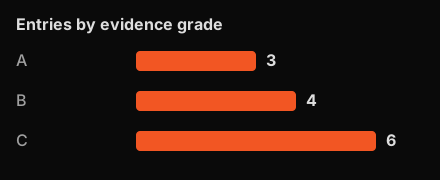
The strongest entries in this document are the ones that deflate something. NU-F-01 and NU-F-02 between them cover 48 randomized trials and a 609-person twelve-month trial, and what they establish is that the dietary pattern somebody picks is not what decides the outcome. NU-P-02 finds that eating more often does not reliably change body composition, and says so on the strength of a meta-analysis whose own authors traced their positive result to a single study. NU-P-04 reports that there is no consensus on a daily water requirement at all.
An app that offers six macro splits and nine food patterns should read those four entries first.
The evidence on energy density is genuinely good and it is the useful half. NU-D-01 is the cleanest result here: given the same meals at three energy densities, people ate the same weight of food every time, took in 1,376, 1,519 and 1,800 calories, and reported no difference in hunger or fullness. That is a mechanism a food log can act on in a way that a macro split is not.
One entry exists because a feature needs it rather than because the research is interesting. NU-P-05 is refrigerated storage. MVIII builds meal-prep plans, and a plan that says a dish keeps a week when it keeps three days is the only claim in this app where being wrong makes somebody ill.
And a section of this document checks the software against itself. See Where the app and this document meet, below. The short version: the computed numbers mostly sit inside the published bands, one departure is deliberate, and the finding worth having is that nothing connects the literals to the entries, so nobody would notice if they drifted apart. An earlier draft of that section claimed three contradictions and two of them did not survive checking.
The entries
NU-P-01Spreading protein across the day
PrescriptionProtein is distributed across the day's meals rather than concentrated, and a meal-prep container is portioned to carry its share. The per-meal dose is specified at BB-N-02 and PL-N-02 and is not restated here. Band: min "protein somewhere in the day", standard "spread across the day's meals", max "an even dose at every meal".
Evidence gradeB
EffectThe widely repeated ceiling of 20 to 25 g of protein per meal is specific to fast-digesting protein given without other macronutrients. Slower proteins, and protein consumed alongside other macronutrients, delay absorption and plausibly extend utilization. While doses above roughly 20 g do raise amino acid oxidation, that is not the fate of all of it, and the review's conclusion is that per-meal intakes above the commonly cited cap are usable [7].
PopulationReview of acute and longer-term studies in resistance-trained and untrained adults.
Sources[7]
CaveatsA narrative review rather than a meta-analysis, by authors who are prolific in this area and whose position it argues for. What it establishes is that the 20 to 25 g cap is not a hard ceiling, which is a smaller claim than "distribution does not matter". Distribution's effect on the total is what BB-N-02b covers, and it is graded B there too.
NU-P-02How many meals a day
PrescriptionMVIII lets the member choose 1 to 5 meals and does not recommend a number. That absence is the prescription. Band: min "no meal structure at all", standard "offer one to five, recommend none", max "a prescribed number of meals".
Evidence gradeC
EffectA meta-analysis with regression across 15 studies initially found feeding frequency positively associated with reductions in fat mass and body fat percentage, and with an increase in fat-free mass. Sensitivity analysis showed the positive findings were the product of a single study, and the authors conclude the results need interpreting with circumspection [6].
Population15 experimental studies.
Sources[6]
CaveatsThis is a deflator and should be read as one. It does not show that meal frequency is irrelevant; it shows that a meta-analysis pointing that way collapsed to one study when it was leaned on. BB-N-02b prescribes 3 to 6 meals for hypertrophy on separate grounds, which is a protein-distribution argument rather than a frequency-and-fat-loss argument. The two are not in conflict and are frequently confused.
NU-P-03Dietary fiber
PrescriptionNone, and that is the finding. MVIII does not track fiber, does not target it, and does not report it, while carrying strong evidence that it matters. Band: min "no mention of fiber", standard "not tracked", max "a daily target reported next to the macros".
Evidence gradeA
EffectA series of systematic reviews and meta-analyses drawing on just under 135 million person-years from 185 prospective studies and 58 clinical trials, assessed with GRADE, quantifying indicators of carbohydrate quality against non-communicable disease incidence, mortality and risk factors, and establishing an evidence base for quantitative recommendations on dietary fiber intake [8].
Population185 prospective studies and 58 randomized trials.
Sources[8]
CaveatsThe evidence is about long-run disease risk, not about body composition or training, which is why it has never bumped into anything MVIII computes. That is an explanation and not a defense. This is the largest and best-graded body of evidence in this document and the app is silent on it. Fiber is a field on almost every food database row the app already reads.
NU-P-04Daily water
PrescriptionMVIII computes a water goal of 35 mL per kilogram of bodyweight per day. Nothing establishes that number, or any number.
Evidence gradeC
EffectAlthough research teams and professional organizations have described total water intakes and Adequate Intakes for children, women and men, there is no widespread consensus regarding human water requirements, and they remain undefined, because of the complexity of the human water regulatory network and large inter-individual differences [11].
PopulationReview across sex and life-stage groups.
Sources[11]
CaveatsThe National Academies Adequate Intake values the app's sources sheet already cites are population survey figures, not requirements, and this review says so explicitly. A per-kilogram rule is a simplification of a figure that was never a requirement in the first place. It is not harmful and it is not evidenced, and both halves of that belong on screen.
NU-P-05Refrigerated storage of cooked food
PrescriptionA cooked meal-prep dish is stated to keep 3 to 4 days refrigerated, and never longer. The refrigerator is assumed at 40 °F or below, food is refrigerated within 2 hours of cooking, and reheating is to 165 °F.
Evidence gradeB
EffectUSDA Food Safety and Inspection Service guidance: use most cooked leftovers within 3 to 4 days; keep the refrigerator at 40 °F or below; refrigerate within 2 hours of cooking, or within 1 hour above 90 °F; reheat leftovers to 165 °F measured with a thermometer, and bring sauces, soups and gravies to a rolling boil. Bacteria grow most rapidly between 40 °F and 140 °F, doubling in as little as 20 minutes [12]. An FAO/WHO expert meeting reviewing Listeria monocytogenes in ready-to-eat foods reports that outbreaks and resultant deaths continue to occur globally and that new quantitative contamination data exists for nearly every factor in the earlier risk assessment [13].
PopulationNational guidance for domestic food handling [12]; international risk assessment [13].
CaveatsThis is the one entry in the whole MVIII evidence system where being wrong makes somebody ill rather than merely mistaken, and it is the reason it exists. Guidance rather than a trial, which is the correct source type: no randomized trial of leftover storage times will ever be run, and the agency that sets the rule is the right authority for it.
Three to four days is a floor across food types, not a per-dish figure. Some dishes keep less. The honest implementation states 3 to 4 days and does not let anything, model or catalog, claim longer without a specific reason. Freezing is a separate question this entry does not cover.
# PART B — Findings
NU-D-01Energy density decides the calories, at a constant weight of food
FindingEighteen normal-weight women were given meals across three two-day sessions with free access to a main entree varying in energy density, matched for palatability. They ate a similar weight of food in all three conditions, taking in 1,376, 1,519 and 1,800 kcal respectively (P < 0.0001). There were no differences in hunger or fullness before meals, after meals, or across the two days. The authors conclude energy density affects intake independent of macronutrient content or palatability, and that overconsumption of high-fat foods may be due to their energy density rather than their fat [1].
Evidence gradeB
Population18 normal-weight women, within-subjects.
Sources[1]
CaveatsOne study, 18 participants, one sex, two-day sessions. It is graded B rather than C because the design isolates the variable unusually cleanly and the result is large. The finding is about a mechanism, not a prescription: nothing here says a member should eat to a density target.
NU-D-02Volume matters independently of density, and can be made of air
FindingTwenty-eight lean men were given isoenergetic yogurt-based milkshakes of identical ingredients and identical weight, varying only in volume (300, 450, 600 mL) through incorporated air. Energy intake at lunch 30 minutes later was 12% lower after the 600 mL preload than after the 300 mL one, with greater reductions in hunger and greater increases in fullness [2].
Evidence gradeC
Population28 lean men, within-subjects.
Sources[2]
CaveatsA single study in one sex on a laboratory preload, and the effect is on the next meal rather than on a day or a week. It is included because it separates volume from density, which nothing else does, and because the implication is unusual: the signal deciding fullness can be moved by something with no mass and no calories.
NU-D-03Fat and carbohydrate together, and the judgment problem
FindingIn an auction task during fMRI, participants were willing to pay more for foods combining fat and carbohydrate than for equally familiar, equally liked and equally caloric foods containing only fat or only carbohydrate, with the potentiated reward associated with response in the dorsal striatum and mediodorsal thalamus. The same study found participants were better able to estimate the energy density of fat-only foods than of fat-plus-carbohydrate foods [3].
Evidence gradeC
PopulationAdult participants in a neuroimaging auction paradigm.
Sources[3]
CaveatsA laboratory valuation task, not eating behavior, and reward response is not intake. The second finding is the one that matters operationally and is the one almost never quoted: the combination people value most is also the one their estimation is worst at. That is the overlap where "I hardly ate anything" is honestly believed and factually wrong.
NU-D-04Density is a large part of it and not all of it
FindingTwenty weight-stable adults were admitted as inpatients and randomized to ultra-processed or unprocessed diets for two weeks each, eating ad libitum. Meals were matched for presented calories, energy density, macronutrients, sugar, sodium and fiber. Energy intake was 508 ± 106 kcal/day greater on the ultra-processed diet (p = 0.0001), from carbohydrate (+280 kcal/d) and fat (+230 kcal/d) but not protein. Participants gained 0.9 ± 0.3 kg on the ultra-processed diet and lost 0.9 ± 0.3 kg on the unprocessed one, with weight change correlated to intake at r = 0.8 [4].
Evidence gradeB
Population20 adults, inpatient, four weeks total.
Sources[4]
CaveatsEnergy density was matched and the overeating happened anyway, which is why this entry sits next to NU-D-01 rather than under it. Density is a real and large lever and it is not the whole mechanism; food form, texture and eating rate remain candidates and this trial cannot separate them. Twenty participants at one site.
NU-D-05Hyper-palatable foods have a definition now
FindingResearch on hyper-palatable foods has used descriptive terms such as "fast foods" and "sweets" which are not standardized and lack specificity. A quantitative definition was developed and applied to the Food and Nutrient Database for Dietary Studies to determine the prevalence of such foods in the US food system [5].
Evidence gradeC
PopulationUS food system database.
Sources[5]
CaveatsA definitional and prevalence paper, carrying no outcome. It is cited so that "hyper-palatable" can be used in MVIII's copy as something countable rather than as an adjective.
NU-F-01The named diet is not what decides the outcome
FindingA Bayesian network meta-analysis of 48 randomized trials including 7,286 people, comparing popular named diets by macronutrient class, adjusted for behavioral support and exercise. Weight loss against no diet at six months was largest for low-carbohydrate diets at 8.73 kg (95% CrI 7.27 to 10.20) and remained substantial at twelve months, with low-fat diets close behind and differences between named programs small [9].
Evidence gradeA
Population7,286 overweight or obese adults across 48 randomized trials.
Sources[9]
CaveatsDifferences between classes were small relative to the difference between dieting and not dieting, which is the finding, and it is routinely quoted as whichever diet came out fractionally ahead. Weight loss is the outcome, not body composition and not adherence beyond twelve months.
NU-F-02And neither genotype nor insulin secretion predicts who should pick which
FindingDIETFITS randomized 609 adults without diabetes to a healthy low-fat or a healthy low-carbohydrate diet for 12 months, delivered through 22 diet-specific group sessions, and additionally tested whether three single-nucleotide-polymorphism genotype patterns or insulin secretion (INS-30) predicted which diet somebody would respond to [10].
Evidence gradeA
Population609 adults aged 18 to 50, BMI 28 to 40, twelve months.
Sources[10]
CaveatsBoth arms emphasized diet quality rather than a macronutrient number, so this compares two well-constructed diets rather than a good diet against a bad one. Read with NU-F-01: the pattern somebody picks matters far less than the fact that they picked one and stayed on it. An app offering six macro splits and nine food patterns is offering preference, and should describe them that way rather than as competing strategies.
NU-F-03New research, October 2026: at the same weight loss, the diet changed what happened in the liver
FindingA randomized trial in adults with obesity, prediabetes and fatty liver compared three diets of very different make-up: very-low-carbohydrate ketogenic, Mediterranean, and very-low-fat plant-forward. Calories were adjusted so every group lost about 10% of body weight. Muscle insulin sensitivity rose about 50% in all three. Liver insulin sensitivity rose two to three times more on the very-low-carbohydrate diet (p < 0.001), and liver fat, hepatic de novo lipogenesis, HbA1c, and 24-hour glucose and insulin fell most on that diet. LDL cholesterol, apolipoprotein B and 24-hour triglycerides did not differ between the diets [14].
Evidence gradeC
PopulationAdults with obesity, prediabetes and hepatic steatosis. The institution's release says 42 were enrolled; the abstract gives no number.
Sources[14]
CaveatsOne trial, and a small one. It does not contradict NU-F-01, which is about how much weight people lose. Here the weight loss was held equal on purpose, and the question was what the same loss did. It says nothing about people without prediabetes and fatty liver.
Protein was probably not equal. By subtraction from the carbohydrate and fat shares in the institution's release (4% and 73% ketogenic, 50% and 35% Mediterranean, 70% and 15% plant-forward), protein was about 23% of calories on the ketogenic diet and about 15% on the other two. The trial registration (NCT02706262) planned 20% for the Mediterranean diet. The abstract does not report protein, so a share of the liver result may belong to protein rather than carbohydrate. UNVERIFIED until the paper's diet table is read.
Figures quoted in press coverage, 67% less liver fat and half no longer prediabetic, are not in the abstract and are not used here. All food was supplied during weight loss, so this measures the diets eaten exactly as written, not as people manage them at home.
# Where the app and this document meet
An earlier draft of this section claimed the app contradicts three of its own published bands. Checked against the entries, two of the three were wrong, and both were wrong in the specific way the entries themselves warn about. What is left is smaller, truer, and more useful.
Can the body only use 20 to 25 g of protein per meal?
No. That figure comes from fast-digesting protein given on its own. Slower proteins eaten with other food behave differently, and higher doses are not simply wasted.
- That the macro split you choose is what determines the result. Differences between named diet classes were small across 48 trials and 7,286 people [9], and a 609-person twelve-month trial found no advantage to low-fat over low-carbohydrate and no predictive value in genotype pattern or insulin secretion [10]. A split is a preference somebody can stick to, and MVIII offers six of them on that basis.
- That eating more frequently improves body composition. The meta-analysis pointing that way collapsed to a single study under sensitivity analysis, and its own authors say so [6].
- That the body can only use 20 to 25 g of protein per meal. That figure comes from fast-digesting protein given alone. Slower proteins with other macronutrients behave differently, and higher doses are not simply wasted [7].
- That there is a known daily water requirement. There is no widespread consensus and the requirement remains undefined [11]. Adequate Intake values are survey figures, not requirements. MVIII's per-kilogram rule is a convenience.
- That a cooked prep dish keeps a week in the fridge. USDA guidance is 3 to 4 days for most cooked leftovers [12]. Nothing in this app, model or catalog, states longer.
- That fat is what makes food easy to overeat. Energy density affected intake independent of macronutrient content, and the authors of that trial attribute overconsumption of high-fat foods to their density rather than their fat [1]. Fat is dense at nine calories a gram, which is a different claim.
- That matching energy density is enough. Density was matched in an inpatient trial and people still ate 508 kcal a day more on ultra-processed food [4].
The 14 sources, checked 26 August 2026
- Bell EA, Castellanos VH, Pelkman CL, Thorwart ML, Rolls BJ. Energy density of foods affects energy intake in normal-weight women. Am J Clin Nutr. 1998. https://doi.org/10.1093/ajcn/67.3.412
- Rolls BJ, Bell EA, Waugh BA. Increasing the volume of a food by incorporating air affects satiety in men. Am J Clin Nutr. 2000. https://doi.org/10.1093/ajcn/72.2.361
- DiFeliceantonio AG, Coppin G, Rigoux L, et al. Supra-Additive Effects of Combining Fat and Carbohydrate on Food Reward. Cell Metab. 2018. https://doi.org/10.1016/j.cmet.2018.05.018
- Hall KD, Ayuketah A, Brychta R, et al. Ultra-Processed Diets Cause Excess Calorie Intake and Weight Gain: An Inpatient Randomized Controlled Trial of Ad Libitum Food Intake. Cell Metab. 2019. https://doi.org/10.1016/j.cmet.2019.05.008
- Fazzino TL, Rohde K, Sullivan DK. Hyper-Palatable Foods: Development of a Quantitative Definition and Application to the US Food System Database. Obesity. 2019. https://doi.org/10.1002/oby.22639
- Schoenfeld BJ, Aragon AA, Krieger JW. Effects of meal frequency on weight loss and body composition: a meta-analysis. Nutr Rev. 2015. https://doi.org/10.1093/nutrit/nuu017
- Schoenfeld BJ, Aragon AA. How much protein can the body use in a single meal for muscle-building? Implications for daily protein distribution. J Int Soc Sports Nutr. 2018. https://doi.org/10.1186/s12970-018-0215-1
- Reynolds A, Mann J, Cummings J, Winter N, Mete E, Te Morenga L. Carbohydrate quality and human health: a series of systematic reviews and meta-analyses. The Lancet. 2019. https://doi.org/10.1016/s0140-6736(18)31809-9
- Johnston BC, Kanters S, Bandayrel K, et al. Comparison of Weight Loss Among Named Diet Programs in Overweight and Obese Adults: A Meta-analysis. JAMA. 2014. https://doi.org/10.1001/jama.2014.10397
- Gardner CD, Trepanowski JF, Del Gobbo LC, et al. Effect of Low-Fat vs Low-Carbohydrate Diet on 12-Month Weight Loss in Overweight Adults and the Association With Genotype Pattern or Insulin Secretion: The DIETFITS Randomized Clinical Trial. JAMA. 2018. https://doi.org/10.1001/jama.2018.0245
- Armstrong LE, Johnson EC. Water Intake, Water Balance, and the Elusive Daily Water Requirement. Nutrients. 2018. https://doi.org/10.3390/nu10121928
- US Department of Agriculture, Food Safety and Inspection Service. Leftovers and Food Safety. https://www.fsis.usda.gov/food-safety/safe-food-handling-and-preparation/food-safety-basics/leftovers-and-food-safety
- FAO and WHO. Listeria monocytogenes in ready-to-eat (RTE) foods: attribution, characterization and monitoring. 2022. https://doi.org/10.4060/cc2400en
- Petersen MC, Smith GI, Farabi SS, Palacios HH, Shankaran M, Hellerstein MK, Patterson BW, Klein S. Effect of diet macronutrient content on the cardiometabolic response to weight loss: A randomized clinical trial. Cell Metab. 2026. https://doi.org/10.1016/j.cmet.2026.07.020