References · progression
Skill & distance progression: the evidence
The path to a first pull-up or a run pace is the least evidenced thing MVIII programs, and this page says so. Force plates have measured how heavy each push-up variation is. No trial has compared one progression order against another, and two of the numbers MVIII prescribes here have no published evidence at all.
Has anyone tested the order of a calisthenics progression?
No. Force plates have measured how heavy each push-up variation is, but no trial has compared one progression order against another.
Entries by grade: A 1, B 2, C 8, none located 3. What the grades mean.
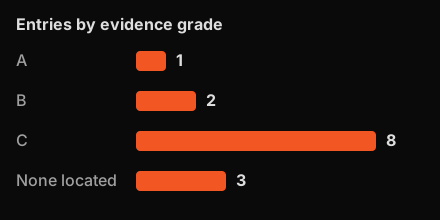
Grades here are weaker than in the other two documents, and weaker in a specific way. The load entries (CA-P-01 to CA-P-04) are force-plate measurements of how heavy each push-up variation is, in samples of eight to twenty-seven people. They measure the stimulus accurately. They are not evidence that training in this order works, because no trial has ever compared one progression order against another for time to a first repetition.
Two entries carry no evidence at all, and both are numbers MVIII prescribes: CA-P-08, the rep scheme for a rep-count goal, and CA-R-03, the session volume for a pace goal. Both are widespread coaching practice with no controlled trial behind them that could be located. They are graded — rather than quietly rounded up.
The single A-grade entry in this document, CA-P-06, argues against a common reason for prescribing negatives rather than for it.
Read the ladders as measured loading arranged by coaching convention, which is what they are.
The entries
CA-P-01Standard push-up load
PrescriptionA standard push-up loads roughly 64–66% of bodyweight at the start position, rising toward 75% as the elbows flex. Used as the reference point every other push-up rung is placed against.
Evidence gradeC
EffectGround reaction force at the normal position measured 66.4% of bodyweight [1]. An independent force-plate study of six variations found the regular push-up around 64% of body mass, and reported that these data can be used to progress push-up intensity as a percentage of body mass [2].
PopulationEight healthy men [1]; twenty-three recreationally fit young adults, mean age 22.5 [2].
CaveatsTwo studies in small samples, measuring acute kinetics rather than training outcome. A push-up is not one load: it climbs as you descend, so a single percentage is a simplification of a curve.
CA-P-02Knee push-up load
PrescriptionAbout 53% of bodyweight. Placed below the standard push-up in the ladder on this measurement.
Evidence gradeC
Effect52.9% of bodyweight at the start position, against 66.4% for the normal variant. Muscle activity in both triceps brachii and pectoralis major was lower during the on-knees variant [1].
PopulationEight healthy men.
CaveatsThe lower EMG alongside the lower force is what makes this a genuine reduction in demand rather than a change in leverage the muscles do not feel. Still a single small study of acute kinetics.
CA-P-03Hands-elevated push-up load
PrescriptionFalls continuously from the standard push-up down to about 41% of bodyweight as the hands rise. Roughly 55% at a 30 cm surface, 41% at 61 cm.
Evidence gradeC
EffectHands elevated on a 30.48 cm box and a 60.96 cm box produced lower ground reaction forces than every other push-up variation tested [2]. A separate study modelling incline push-ups found peak force decreasing as the incline steepened, with mean maximum force at 10° exceeding 30° by 71.12 N [3].
PopulationTwenty-three recreationally fit young adults [2]; twenty-seven male university students [3].
CaveatsThis continuity is why MVIII uses an incline push-up rather than a knee push-up as its main scaling rung: an incline is a dial that fits whatever surface somebody has, where a knee push-up is one fixed load. Neither study measured a wall push-up, so its load is inferred from the far end of the same scale rather than measured.
CA-P-04Feet-elevated push-up load
PrescriptionAbout 70% of bodyweight at a 30 cm surface, up to 74% at 61 cm.
Evidence gradeC
EffectPush-ups with the feet elevated produced higher ground reaction forces than all other push-up variations tested [2].
PopulationTwenty-three recreationally fit young adults.
Sources[2]
CaveatsThe gap from a standard push-up to the hardest feet-elevated version is about ten points of bodyweight, which is a much smaller step than any of the steps below the standard push-up. Progress past a full push-up is therefore mostly a matter of repetitions rather than leverage, which is why MVIII switches to a rep scheme there.
CA-P-05Band-assisted pull-up, load removed
PrescriptionA long band takes off enough load to roughly double or triple the repetitions somebody can perform. Placed below the negative pull-up in the ladder.
Evidence gradeC
EffectParticipants performed 11.35 repetitions unassisted, 17.61 with a band arranged vertically (feet inside the band) and 28.03 with the band arranged horizontally (feet on top) [4].
PopulationThirty-three university kinesiology students, 26 male and 7 female.
Sources[4]
CaveatsRepetitions are a proxy for the load removed, not a measurement of it. The two band arrangements differ enough that the same band is effectively two different rungs depending on how it is tied, and the app cannot tell which way anybody tied theirs.
CA-P-06Eccentric-only training and concentric strength
PrescriptionNegatives are programmed as loaded practice at the bar, late in the ladder. They are not programmed as a faster route to the first repetition.
Evidence gradeA — contested application
EffectAcross 27 studies, eccentric-only training produced greater gains in eccentric strength than concentric-only training (Hedges' g 1.51; 27% versus 10%; p < 0.001). No difference was evident between the training modalities for changes in concentric contraction strength [5].
PopulationHealthy adults, 27 studies, 162 study results.
Sources[5]
CaveatsThis is the strongest evidence in the document and it cuts against the usual argument for doing negatives. Pulling yourself over a bar is a concentric action, and eccentric-only training did not improve concentric strength more than concentric training did. The isokinetic protocols in these studies are also not identical to a slow lowering from a bar. A negative remains a defensible way to accumulate time under load at the movement; the claim that it is the fast route is not supported.
CA-P-07Training frequency
PrescriptionLadder work is placed on the member's existing training days, two to three exposures per week. No additional sessions are asked for.
Evidence gradeB
EffectA meta-analysis of weekly training frequency found the existing data does not provide a strong correlation between increased weekly frequency and maximal strength gain in upper- and lower-body exercises for a mixed population [6].
PopulationMixed trained and untrained.
Sources[6]
CaveatsFrequency is how weekly volume gets distributed rather than an independent driver, which is precisely what supports inheriting the member's existing schedule instead of prescribing more days.
CA-P-08Submaximal set effort for a rep-count goal
PrescriptionFive sets at approximately 50% of the best single set, when the goal is a repetition count and the movement itself is already achievable.
Evidence grade— (no controlled trial located)
EffectNo trial isolating this scheme was located.
Population—
Sources—
CaveatsThis practice is widespread and has a well-known name. It has no controlled trial behind it that could be found. The number is a convention MVIII follows and states as a convention. It is recorded here rather than omitted, because a number the app prescribes with nothing behind it should be visible as such rather than absent from the table.
CA-R-01Interval training versus continuous running
PrescriptionA pace goal is built from repeats at the goal pace rather than from continuous running below it.
Evidence gradeB
EffectMatched for total work and frequency, four-minute high-intensity intervals produced approximately a 7% increase in VO2max over eight weeks and outperformed continuous moderate running, which produced no significant change [7].
PopulationForty trained men.
Sources[7]
CaveatsOne trial in trained men. The size of the effect in untrained runners, and the transfer specifically to holding a target pace rather than to VO2max, are not established by it.
CA-R-02Weekly distance increase
PrescriptionA distance goal is approached in steps of roughly 10–15% of the target. This is a way to approach a distance, not an injury-prevention measure.
Evidence gradeC — contested
Effect532 novice runners preparing for a four-mile event were randomised to a graded thirteen-week program built on the ten percent rule or to a standard eight-week program. Running-related injury occurred in 21% of the graded group and 20% of the standard group. No difference [8].
PopulationNovice runners, n = 532.
Sources[8]
CaveatsThe most repeated rule in running has been tested and does not do what it is famous for. MVIII uses steps of this size so a target is approached rather than jumped at, and never presents them as protective.
CA-R-03Session volume for a pace goal
PrescriptionRepeats totalling about 1.5 times the goal distance in one session.
Evidence grade— (no controlled trial located)
EffectNo trial isolating session volume for a goal-pace session was located.
Population—
Sources[9]
CaveatsWidespread coaching practice with nothing published isolating the total. The polarised training-intensity meta-analysis cited speaks to how hard versus easy work should be distributed across a week — a 75–80% low-intensity and 15–20% high-intensity split, with polarised distribution favoured for VO2peak only in interventions under twelve weeks and in highly trained athletes — and does not speak to how much work belongs in one session. It is cited as the nearest adjacent evidence, not as support.
# PART B — Findings
CA-F-01A first pull-up is a long project
FindingAfter twelve weeks of combined strength and aerobic conditioning, four of seventeen college-age women could perform a pull-up. Upper-body strength rose approximately 36% and body fat fell. Successful participants had significantly greater 1RM strength and strength-to-mass ratios [10].
Evidence gradeC
PopulationCollege-age women, n = 17 completing.
Sources[10]
CaveatsA single study in one population. It is the most honest number in this document: general training moves everything in the right direction and frequently does not reach the skill within a season. This is why MVIII shows the rung a member is on rather than a predicted date, and why a target date on a goal is never rendered as a deadline or a countdown.
CA-F-02Pulldown work transfers to pull-up performance
FindingEight weeks of lat pull-down resistance training improved pull-up endurance performance and reduced antagonist coactivation [11].
Evidence gradeC
PopulationRecreationally active male college students.
Sources[11]
CaveatsA single trial in one population. It supports the early rungs of the pull-up ladder being loaded pulling of any kind rather than bar work exclusively, which is what makes the ladder usable by a member who owns no bar.
CA-F-03Straight legs are the harder lever
FindingA hanging leg raise presents a longer resistance arm at the hip than a hanging knee raise and therefore demands more hip flexor and abdominal torque at the same bodyweight.
Evidence grade— (mechanics; no comparative trial located)
Population—
Sources—
CaveatsThis is mechanical reasoning rather than a measured comparison, and it is the entire basis for that rung order. It is listed so the reasoning is visible rather than implied.
Does the ten percent mileage rule prevent running injuries?
The rule was tested and it did not hold. In 532 novice runners, injury rates were 21% on the ten percent program and 20% on a standard one. It is one of five progression rules listed here.
- "Negatives are the fastest way to your first pull-up." The best available evidence says the opposite of the usual reasoning. A meta-analysis of 27 studies found eccentric-only training produced large gains in eccentric strength and no greater gain in concentric strength than concentric training did [5]. Pulling yourself over a bar is concentric. Negatives put you under load at the bar, which is worth something, and the claim that they are the fast route is not supported.
- "Increase your weekly mileage by ten percent to avoid injury." The most repeated rule in running, and it has been tested. 532 novice runners were randomised to a thirteen-week program built on the ten percent rule or to a standard eight-week program. Injury rates were 21% and 20% [8]. The rule is a reasonable way to approach a distance in steps and it is not a way to avoid getting hurt.
- "There is a correct order to learn calisthenics progressions in." No trial has compared one progression order against another for time to a first repetition. What has been measured is how heavy each variation is [1][2][3], and MVIII orders the push-up ladder by those measurements. Where no measurement exists, the order is coaching convention and is labelled as such.
- "Practising a movement often, well short of failure, is the best way to raise a rep count." Widely prescribed, and no controlled trial supporting it could be located. See
CA-P-08. The frequency meta-analysis that does exist found frequency mattered little once weekly volume was held constant [6], which is a different claim and does not support this one. - "A wall push-up is the natural first step." Force-plate work has never measured a wall push-up, so its load is unknown. What is measured is that hands-elevated push-ups scale continuously from about 64% of bodyweight down to 41% as the surface rises [2][3]. A wall is the far end of that scale rather than a separate exercise, and it is in the ladder only for members who have no surface between waist height and a wall.
The 11 sources, checked 21 August 2026
- Gouvali MK, Boudolos K. Dynamic and electromyographical analysis in variants of push-up exercise. J Strength Cond Res. 2005;19(1):146-151. https://doi.org/10.1519/14733.1
- Ebben WP, Wurm B, VanderZanden TL, Spadavecchia ML, Durocher JJ, Bickham CT, Petushek EJ. Kinetic analysis of several variations of push-ups. J Strength Cond Res. 2011;25(10):2891-2894. https://doi.org/10.1519/JSC.0b013e31820c8587
- Wu H, Zhai H, Ma R, Wei H. A predictive model for vertical ground reaction force during incline push-ups. Sci Rep. 2025;15:44454. https://doi.org/10.1038/s41598-025-28012-7
- Piper TJ, Weiman M, Narvaez M, Piper W. The effects of elastic band assistance during pull-ups. J Aust Strength Cond. 31(3). https://strengthandconditioning.org/jasc-31-3/3828-original-scientific-research-study-the-effects-of-elastic-band-assistance-during-pull-ups
- Eccentric-only versus concentric-only isokinetic strength training effects on maximal voluntary eccentric, concentric and isometric contraction strength: a systematic review and meta-analysis. Sports Med Open. 2025. https://doi.org/10.1186/s40798-025-00887-w
- Ralston GW, Kilgore L, Wyatt FB, Buchan D, Baker JS. Weekly training frequency effects on strength gain: a meta-analysis. Sports Med Open. 2018;4:36. https://doi.org/10.1186/s40798-018-0149-9
- Helgerud J, Høydal K, Wang E, et al. Aerobic high-intensity intervals improve VO2max more than moderate training. Med Sci Sports Exerc. 2007;39(4):665-671. https://doi.org/10.1249/mss.0b013e3180304570
- Buist I, Bredeweg SW, van Mechelen W, Lemmink KA, Pepping GJ, Diercks RL. No effect of a graded training program on the number of running-related injuries in novice runners: a randomized controlled trial. Am J Sports Med. 2008;36(1):33-39. https://doi.org/10.1177/0363546507307505
- Oliveira PS, Boppre G, Fonseca H. Comparison of polarized versus other types of endurance training intensity distribution on athletes' endurance performance: a systematic review with meta-analysis. Sports Med. 2024. https://doi.org/10.1007/s40279-024-02034-z
- Flanagan SP, Vanderburgh PM, Borchers SG, Kohstall CD. Training college-age women to perform the pull-up exercise. Res Q Exerc Sport. 2003;74(1):52-59. https://doi.org/10.1080/02701367.2003.10609064
- Li Z, et al. Eight-week lat pull-down resistance training with joint instability leads to superior pull-up endurance performance and reduced antagonist coactivation in recreationally active male college students. Eur J Sport Sci. 2025. https://doi.org/10.1002/ejsc.12243