References · self-image
Self-image and behaviour change: the evidence
The psychology behind how Coach 8 talks to you is weaker evidence than MVIII's training research. Most of it is measured on self-report scales. Its strongest rows, like Sheeran's 204 experimental tests of self-efficacy, are about what people do, not how they feel. Three of MVIII's own choices here have no evidence at all.
Is the self-image research as strong as the training research?
No. Most of it is measured on self-report scales. Its A-grade rows, like Sheeran's 204 experimental tests of self-efficacy, are about what people do, not how they feel.
Entries by grade: A 1, B 7, C 9, none located 3. What the grades mean.
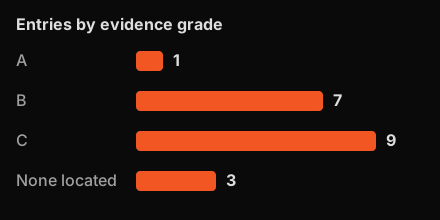
This document's evidence is weaker and softer than the training documents', and weak in a particular direction. Almost everything here is measured on a self-report scale rather than on a bar. Where the training documents can say a muscle grew, this one can mostly say a questionnaire score moved.
Its strongest rows are about what people do, not about how they feel. Sheeran's 204 experimental tests of changed self-efficacy and Gollwitzer and Sheeran's 94 tests of implementation intentions are genuinely A-grade, and both measure behaviour. The rows about body image and self-concept are weaker, and one of them says so about itself: Alleva's meta-analysis of body-image interventions found a small-to-medium effect that shrank to small once corrected for bias within and across studies, and found the effects on beauty-ideal internalisation and social comparison were no longer reliable at all after correction. That is reported here rather than quietly omitted.
Three entries carry no evidence whatsoever, and all three are choices MVIII has already made and defends in public. SI-P-10, the register Coach 8 speaks in. SI-P-11, removing shaming language from an automated coach by code rather than by instruction. SI-P-12, the absence of streaks.
Each was searched for specifically. Each came back empty. They are graded — rather than propped up with the nearest adjacent finding, because the honest position is that MVIII's most-defended product decision is a decision, not a finding.
The one place this document argues against a thing the app does is SI-P-05. Coach 8's attribution rule leans on praising process rather than ability, and two large meta-analyses have deflated that literature nearly to zero. The rule is kept for other reasons, stated in the row, and marked contested.
The entries
SI-P-01Motivation quality the app supports
PrescriptionSupport autonomous motivation (the member's own reasons) over controlled motivation (pressure, obligation, external reward). Coach 8 hands back a choice rather than an instruction wherever a choice exists. Band: min "avoid explicit pressure", standard "hand back a choice and name the member's own reason", max "structured autonomy-support protocol with need-satisfaction measurement".
Evidence gradeB
EffectA systematic review of 66 empirical studies found consistent support for a positive relation between more autonomous forms of motivation and exercise, with identified regulation predicting short-term adoption more strongly and intrinsic motivation more predictive of long-term adherence [1]. A meta-analysis of 73 SDT-informed intervention studies found small-to-medium changes in motivational constructs and small positive changes in health behaviour at end of intervention and at follow-up, with increases in need support and autonomous motivation, but not controlled motivation, associated with positive behaviour change [2].
Population66 studies of exercise and physical activity, experimental, cross-sectional and prospective [1]; 73 experimental studies across health promotion and disease management [2].
CaveatsEffects in [2] are described by its own authors as modest and heterogeneous. Most of [1] is correlational. The construct is measured by self-report throughout. Nothing here establishes that an app can move autonomous motivation, only that autonomous motivation is the kind that predicts adherence.
SI-P-02What training gets framed around
PrescriptionFrame training around what it does for the member's daily life, not around distant health outcomes and not around appearance. Band: min "avoid appearance framing", standard "name the near-term quality-of-life benefit", max "explicit values-clarification exercise".
Evidence gradeC
EffectIn a year-long mixed-method study, participants holding quality-of-life superordinate goals reported more exercise participation than those with current-health goals (p < 0.01) and healthy-aging goals (p = 0.06), despite valuing all three equally [3]. Appearance and weight goals were among the four superordinate goal types identified and did not lead the field.
PopulationRandom sample of 226 healthy midlife women aged 40 to 60.
Sources[3]
CaveatsOne study, one narrow demographic, self-reported exercise, and observational rather than an intervention. The equal-attainment-value finding is what makes it interesting: the difference is not that people care less about healthy aging, it is that distant goals move behaviour less. Generalising from midlife women to every MVIII member is not supported.
SI-P-03Response to a lapse
PrescriptionAfter a lapse, respond with self-compassion rather than self-criticism. Coach 8 never treats a missed week as a debt or a character finding. Band: min "say nothing", standard "name the calendar, hand back today", max "an explicit self-compassion prompt".
Evidence gradeB
EffectA meta-analysis of 27 randomized controlled trials found self-compassion interventions improved 11 psychosocial outcomes against controls, with a moderate effect on self-criticism (Hedges' g = 0.56), stress (g = 0.67), depression (g = 0.66) and self-compassion itself (g = 0.75) [4]. A small-scale meta-analysis of 15 independent samples found self-compassion positively associated with the practice of health-promoting behaviours including exercise, sleep and stress management across all 15 samples, with a small average effect (r = .25) [5].
Population27 RCTs across diverse adult populations [4]; 15 samples, N = 3,252 [5].
CaveatsThe self-compassion meta-analysis [4] states plainly that intervention type was too diverse to analyze specific categories and that publication bias may be present. The health-behaviour association [5] is correlational and self-report throughout, and its effect is small. Neither tested an app, a coach persona, or a single sentence delivered after a missed session, which is what MVIII actually does. The inference from "a self-compassion intervention helps" to "a coach that does not shame you helps" is a step this evidence does not take.
SI-P-04Response to a missed session
PrescriptionName the absence once as a fact about the calendar, then hand back today. Never as a debt, never as forgiveness, never as a character judgement. Band: min "do not mention it", standard "name it once, then pivot to today", max "name it and offer a structured recovery plan".
Evidence gradeC
EffectDerived from the harms rather than from a positive trial. Weight stigma is not a beneficial tool for changing behaviour and interferes with intervention efforts [6], and experienced stigma predicts avoidance of exercise in people who have internalised societal attitudes about weight, with avoidance in turn negatively correlated with self-reported strenuous exercise [7]. The self-compassion effect on self-criticism [4] is the positive half.
PopulationReview of public-health evidence [6]; 111 adults, cross-sectional and correlational [7].
CaveatsNo trial has tested how an automated coach should word a re-entry message. This row is an inference from what harms toward what to avoid, which is weaker than a prescription and is graded accordingly. SI-P-11 records the gap directly.
SI-P-05Attribution of a good session
PrescriptionAttribute what went well to what the member did, a decision or turning up or the boring thing done again, and never to talent, body or luck. Attribute what went badly to the week, the plan or the load, never to the person. Band: min "do not attribute to fixed traits", standard "name the controllable action", max "explicit process-praise framing".
Evidence gradeC · contested
EffectThe theory that praising malleable effort rather than fixed ability improves outcomes has been substantially deflated. Across 273 studies (N = 365,915) the mind-set to achievement relationship was weak, and across 43 intervention studies (N = 57,155) intervention effects on achievement were weak [8]. A later review of 63 studies (N = 97,672) found major shortcomings in design, analysis and reporting, an overall effect of d = 0.05 that was nonsignificant after correcting for publication bias, and that authors with a financial incentive to report positive findings published significantly larger effects than authors without one [9]. Restricted to the 13 studies that demonstrably shifted mindsets as intended, the effect was d = 0.04 and nonsignificant.
PopulationSchool and university students, academic achievement outcomes. Not exercisers, and not a gym.
CaveatsThis row argues against a rule the app keeps. MVIII retains controllable-action attribution for two reasons the evidence does support rather than for the mindset claim: it is the only kind of praise that cannot become appearance-contingent (SI-H-02), and it is what keeps a compliment from being a claim about the member's body (SI-H-01). Both meta-analyses are in an academic domain, and neither tested attribution language from a coach. Anyone reading this row as support for growth-mindset framing is reading it backwards.
SI-P-06How the app talks about the body
PrescriptionTalk about what the body does, never about how it looks. Every capability the app reports is an action performed. No weight, no measurement, no body composition, no photo, in either the critical or the encouraging direction. Band: min "no negative appearance comment", standard "functionality only, in both directions", max "structured functionality-writing intervention".
Evidence gradeB
EffectA randomised trial of a structured programme training women to focus on body functionality produced greater appearance satisfaction, functionality satisfaction and body appreciation, and lower self-objectification, against an active control, with small-to-medium partial eta-squared effects held at one-week follow-up [10]. Across 62 tests of stand-alone body-image interventions (N = 3,846), 12 change techniques were associated with improvement [11]. Exercise itself improves body image against controls with a small effect [12].
Population81 women, mean age 22.8, with pre-existing negative body image [10]; 62 intervention tests [11]; 57 exercise interventions [12].
CaveatsThe functionality trial [10] is a single trial in women with negative body image, with a one-week follow-up, and it is the first of its kind by its own description. The intervention meta-analysis [11] is the honest one: the body-image effect (d+ = 0.38) was inflated by bias both within and across studies and became small once corrected, and the effects on beauty-ideal internalisation and social comparison were no longer reliable after correction. The direction is supported. The magnitude is not.
SI-P-07Mastery experience, named back
PrescriptionWhen the log shows the member did something they had not done before, say so. Mastery experience is the input to self-efficacy that an app can actually observe, and self-efficacy is one of the few constructs here shown experimentally to cause behaviour change rather than merely correlate with it.
Evidence gradeA
EffectAcross 204 experimental tests that randomly assigned participants to a treatment increasing the cognition, experimentally induced changes in self-efficacy produced medium changes in intention (d+ = .51) and small-to-medium changes in behaviour (d+ = .47), the largest behaviour effect of the three cognitions tested. Effects were generally not qualified by study quality, theoretical basis, methodological characteristics or features of the targeted behaviour [13].
Population204 experimental tests across health behaviours.
Sources[13]
CaveatsThis establishes that raising self-efficacy raises behaviour. It does not establish that naming a past achievement raises self-efficacy, which is the specific step MVIII takes. That step is Bandura's theoretical claim, and the foundational citation for it was dropped from this document during verification rather than encoded unread. Treat the row as strong on the destination and unevidenced on the route.
SI-P-08Identity language
PrescriptionWhere the record supports it, reflect what the member has repeatedly done rather than instructing them who to be. The app never tells a member they are an athlete. It tells them what they trained.
Evidence gradeC
EffectA random-effects meta-analysis of 32 data-sets found the point estimate between physical-activity identity/schema and behaviour was r = .44 (CI .39 to .48), invariant to study characteristics. Identity had reliable evidence as a moderator of the intention-behaviour relationship [14].
Population62 independent data-sets, 32 available for meta-analysis, described by the review as primarily of modest quality.
Sources[14]
CaveatsCorrelational. An r of .44 between identity and behaviour is equally consistent with training building identity and with identity driving training, and the review calls explicitly for intervention designs to establish direction. The review also notes identity created negative affect under hypothetical identity-discrepant situations, which is a direct argument against telling somebody they are a lifter and then watching them miss a week. That caveat is why MVIII reflects the record instead of assigning a label.
SI-P-09Intensity and how the session felt
PrescriptionProgramme intensity that a member can complete without misery, and let self-selected intensity stand where the goal permits. How a session felt is a determinant of whether the next one happens.
Evidence gradeB
EffectA review of 33 studies published 1999 to 2009 found pleasure reduced mainly above the ventilatory or lactate threshold, pleasant changes at sub-threshold intensities for most individuals, large inter-individual variability close to the threshold, and homogeneously negative changes above it. Self-selected rather than imposed intensity appeared to foster greater tolerance of higher intensities [15].
Population33 studies of exercise intensity and affective response.
Sources[15]
CaveatsThis is the one row in this document that bears on programming rather than on language, and it sits in tension with the training documents, which prescribe proximity to failure for hypertrophy. The tension is real and is not resolved here: a set taken close to failure is above threshold by design. MVIII's position is that the goal decides the intensity and this row decides the framing around it, not the load.
SI-P-10Coach register and adherence
PrescriptionCoach 8 speaks dry, blunt, and occasionally sarcastic, at roughly one line in nine carrying real attitude. MVIII prescribes this with nothing published behind it.
Evidence grade—
EffectNo systematic review or controlled trial comparing coach personas, registers or tones of voice for effect on training adherence was located. The search was made specifically for it.
PopulationNone.
SourcesNone.
CaveatsThis is a taste decision by the people who built the app, and it is the single most visible thing about the product. It is stated here rather than justified by pointing at the autonomy-support literature, which is about the content of what a coach says and not about whether it is funny.
SI-P-11Removing shaming language by code
PrescriptionMVIII filters shaming, guilt and appearance-contingent language out of Coach 8's output deterministically, after the model answers, rather than asking a model not to produce it. Nothing published supports the retention effect of doing so.
Evidence grade—
EffectNo trial of removing shaming language from an automated coach, and its effect on retention or adherence, was located. SI-H-01 and SI-H-02 establish that the language harms. Neither establishes what filtering it out buys.
PopulationNone.
SourcesNone.
CaveatsThe harms evidence is real and the inference is reasonable. It is still an inference, and the distance between "weight stigma reduces exercise in a cross-sectional sample" and "a code-level filter on a coach's sentences improves retention" is several studies wide, none of which exist.
SI-P-12Streak mechanics
PrescriptionMVIII has no streaks anywhere. Consistency is measured in weeks trained, which only rises, and nothing earned is ever revoked. This is a decision, not a finding.
Evidence grade—
EffectNo controlled trial isolating streak mechanics in a training or health app, and measuring long-run adherence, was located. The loss-aversion argument commonly given for and against streaks is a theoretical extrapolation from decision-making research conducted in neither a gym nor an app.
PopulationNone.
SourcesNone.
CaveatsThe nearest supporting material is SI-H-01 on stigma and SI-P-03 on lapse response, and neither is about a counter. MVIII's position is that a mechanic whose entire emotional weight comes from breaking is a bad thing to hand somebody, and that position is asserted rather than measured. Anyone claiming published evidence that streaks work, in either direction, is overclaiming.
# PART B — Findings
SI-F-01Exercise improves body image, by a little
FindingAcross 57 interventions with pre- and post-data for exercise and control groups, exercise conditions improved body image against controls, with a small random effect. Participant age, publication year, exercise frequency and exercise specificity moderated the effect size [12].
Evidence gradeB
Population57 exercise interventions.
Sources[12]
CaveatsThe authors state that research on the mechanisms and the dose-response required for body-image change is still needed. Training improves how people feel about their bodies. It does so modestly, and nobody knows how much training it takes.
SI-F-02Body-image intervention effects shrink under correction
FindingStand-alone body-image interventions produced a small-to-medium improvement (d+ = 0.38), a small-to-medium reduction in beauty-ideal internalisation (d+ = -0.37) and a large reduction in social comparison tendencies (d+ = -0.72). After correcting for bias within and across studies, only the body-image effect remained reliable, and only at small magnitude. The other two were no longer reliable at all [11].
Evidence gradeB
Population62 tests, N = 3,846.
Sources[11]
CaveatsThis is the most important row in Part B and the reason SI-P-06's magnitude claim is deliberately weak. It is included precisely because the uncorrected numbers are the ones usually quoted.
SI-F-03Identity tracks behaviour, direction unknown
FindingIdentity/schema and physical activity correlate at r = .44, invariant to study characteristics, across 32 data-sets of primarily modest quality [14].
Evidence gradeC
Population62 data-sets, 32 meta-analysed.
Sources[14]
CaveatsCross-sectional and prospective, not experimental. The review calls for interventions to increase identity, which is another way of saying nobody has yet shown you can.
SI-F-04Positive body image is a distinct, measurable thing
FindingBody appreciation, meaning acceptance of and respect for one's body, is measurable as a unidimensional construct invariant across sex and sample type, with supported internal consistency, test-retest reliability and construct validity [16].
Evidence gradeC
Population820 women and 767 men, college and online community samples.
Sources[16]
CaveatsA psychometric validation, not an outcome study. It is cited because it establishes that "feeling worse about your body" and "feeling good about your body" are not one scale read in two directions, which is the assumption most fitness marketing runs on.
# PART C — Harms
SI-H-01Stigma and shame do not motivate
FindingWeight stigma is not a beneficial tool for reducing obesity. It threatens health, generates health disparities, and interferes with effective intervention, despite the common perception that stigmatisation is justifiable and may motivate healthier behaviour [6]. Experienced weight stigma correlates positively with body dissatisfaction, drive for thinness and bulimic symptoms, and negatively with state and trait self-esteem; in people high in internalised anti-fat attitudes it predicts avoidance of exercise, which in turn correlates negatively with self-reported strenuous exercise [7].
Evidence gradeB for the public-health conclusion [6], C for the exercise-avoidance mechanism [7]
PopulationReview of published evidence [6]; 111 adults, cross-sectional [7].
CaveatsThe exercise-avoidance study [7] is a small cross-sectional sample and cannot establish direction. The interesting half is the moderation: people low in internalised attitudes were relatively unaffected by stigma, which means the harm lands hardest on exactly the people a fitness app is most likely to reach. This entry is the citation behind MVIII's shame filter.
SI-H-02Self-worth staked on appearance is a vulnerability
FindingSelf-esteem rises and falls around its typical level in response to success and failure in the domains on which a person has staked their self-worth. Contingencies of self-worth, rather than the level of self-esteem, explain how self-esteem is implicated in affect, cognition and self-regulation, and raise the question of whether such contingencies are primarily a resource or a vulnerability [17].
Evidence gradeC
PopulationTheoretical model synthesising the self-esteem literature.
Sources[17]
CaveatsA model paper, not a trial, and graded accordingly. It is the clearest available statement of why "you'll feel better about yourself once you lean out" is the same sentence as an insult with a delay on it: both make the member's worth conditional on a body outcome, and only one of them sounds unkind. This entry is the citation behind MVIII's appearance filter, which catches praise rather than insult.
SI-H-03Appearance and weight goals underperform
FindingAmong four superordinate exercise goal types identified in midlife women, quality-of-life goals were associated with more exercise participation than current-health or healthy-aging goals despite equal attainment value. Appearance and weight goals were one of the four and did not lead [3].
Evidence gradeC
Population226 healthy women aged 40 to 60, one year.
Sources[3]
CaveatsObservational, one demographic, self-reported exercise.
SI-H-04Social comparison and beauty-ideal internalisation
FindingInterventions reduce beauty-ideal internalisation (d+ = -0.37) and social comparison tendencies (d+ = -0.72), but neither effect survives correction for bias [11].
Evidence gradeC
Population62 intervention tests, N = 3,846.
Sources[11]
CaveatsListed as a harm because the constructs are harms, not because the size of the fix is established. It is not. This is the honest basis for MVIII having no feed, no leaderboard and no member-to-member comparison: the mechanism is well described, and the evidence that anything reliably reduces it is not.
Do effort praise or tough love make people train?
Neither holds up. Two large meta-analyses deflate effort praise, and shame or “no excuses” framing is directly contradicted. They are two of seven claims MVIII leaves out.
- That praising effort rather than ability produces better outcomes. Two large meta-analyses deflate it: weak relationships across 273 studies and 43 interventions [8], and an overall d = 0.05 that was nonsignificant after correcting for publication bias across 63 studies, with larger effects published by authors holding a financial incentive [9]. MVIII keeps controllable-action attribution for a different and stated reason, namely that it is the only form of praise that cannot become a claim about the member's body.
- That shame, tough love or "no excuses" framing motivates people to train. Directly contradicted. Weight stigma interferes with intervention and predicts exercise avoidance in the people most likely to have internalised it [6][7].
- That telling somebody they will feel better about themselves once they change their body is encouragement. It makes self-worth contingent on a body outcome, which is the vulnerability [17], and it is caught by the same filter as an insult.
- That appearance-based motivation sustains training. Appearance and weight goals did not lead exercise participation even among people who valued them equally to other goals [3].
- That streaks improve long-run adherence. No controlled trial isolating streak mechanics in a training app was located, in either direction. Anyone asserting the benefit or the harm from evidence is overclaiming. MVIII's refusal is a product decision, recorded as one at
SI-P-12. - That body-image interventions produce large, reliable reductions in social comparison. The uncorrected effect is large (d+ = -0.72) and is widely quoted. It does not survive correction for bias [11].
- That a coach persona's tone has a measurable effect on whether people keep training. Nothing was located.
SI-P-10states the gap rather than filling it.
The 17 sources, checked 25 August 2026
- Teixeira PJ, Carraça EV, Markland D, Silva MN, Ryan RM. Exercise, physical activity, and self-determination theory: A systematic review. Int J Behav Nutr Phys Act. 2012. https://doi.org/10.1186/1479-5868-9-78
- Ntoumanis N, Ng JYY, Prestwich A, et al. A meta-analysis of self-determination theory-informed intervention studies in the health domain: effects on motivation, health behavior, physical, and psychological health. Health Psychology Review. 2021. https://doi.org/10.1080/17437199.2020.1718529
- Segar ML, Eccles JS, Richardson CR. Rebranding exercise: closing the gap between values and behavior. Int J Behav Nutr Phys Act. 2011. https://doi.org/10.1186/1479-5868-8-94
- Ferrari M, Hunt C, Harrysunker A, Abbott MJ, Beath AP, Einstein DA. Self-Compassion Interventions and Psychosocial Outcomes: a Meta-Analysis of RCTs. Mindfulness. 2019. https://doi.org/10.1007/s12671-019-01134-6
- Sirois FM, Kitner R, Hirsch JK. Self-compassion, affect, and health-promoting behaviors. Health Psychology. 2015. https://doi.org/10.1037/hea0000158
- Puhl RM, Heuer CA. Obesity Stigma: Important Considerations for Public Health. Am J Public Health. 2010. https://doi.org/10.2105/ajph.2009.159491
- Vartanian LR, Novak SA. Internalized Societal Attitudes Moderate the Impact of Weight Stigma on Avoidance of Exercise. Obesity. 2011. https://doi.org/10.1038/oby.2010.234
- Sisk VF, Burgoyne AP, Sun J, Butler JL, Macnamara BN. To What Extent and Under Which Circumstances Are Growth Mind-Sets Important to Academic Achievement? Two Meta-Analyses. Psychol Sci. 2018. https://doi.org/10.1177/0956797617739704
- Macnamara BN, Burgoyne AP. Do growth mindset interventions impact students' academic achievement? A systematic review and meta-analysis with recommendations for best practices. Psychological Bulletin. 2023. https://doi.org/10.1037/bul0000352
- Alleva JM, Martijn C, Van Breukelen GJP, Jansen A, Karos K. Expand Your Horizon: A programme that improves body image and reduces self-objectification by training women to focus on body functionality. Body Image. 2015. https://doi.org/10.1016/j.bodyim.2015.07.001
- Alleva JM, Sheeran P, Webb TL, Martijn C, Miles E. A Meta-Analytic Review of Stand-Alone Interventions to Improve Body Image. PLoS ONE. 2015. https://doi.org/10.1371/journal.pone.0139177
- Campbell A, Hausenblas HA. Effects of Exercise Interventions on Body Image: A Meta-analysis. J Health Psychol. 2009. https://doi.org/10.1177/1359105309338977
- Sheeran P, Maki A, Montanaro E, et al. The impact of changing attitudes, norms, and self-efficacy on health-related intentions and behavior: A meta-analysis. Health Psychology. 2016. https://doi.org/10.1037/hea0000387
- Rhodes RE, Kaushal N, Quinlan A. Is physical activity a part of who I am? A review and meta-analysis of identity, schema and physical activity. Health Psychology Review. 2016. https://doi.org/10.1080/17437199.2016.1143334
- Ekkekakis P, Parfitt G, Petruzzello SJ. The Pleasure and Displeasure People Feel When they Exercise at Different Intensities. Sports Medicine. 2011. https://doi.org/10.2165/11590680-000000000-00000
- Tylka TL, Wood-Barcalow NL. The Body Appreciation Scale-2: Item refinement and psychometric evaluation. Body Image. 2015. https://doi.org/10.1016/j.bodyim.2014.09.006
- Crocker J, Wolfe CT. Contingencies of self-worth. Psychological Review. 2001. https://doi.org/10.1037/0033-295x.108.3.593