References · skin
Skin after weight loss: the evidence
Almost nothing promised to tighten loose skin after major weight loss has been tested. The entries about changing loose skin carry the weakest grades in the whole MVIII library. Protein, slower weight loss and collagen have all been promoted as fixes, and none of the three has been shown to work.
Can diet or exercise tighten loose skin?
Nothing tested says so. The entries about changing loose skin carry the weakest grades in the whole MVIII library.
Entries by grade: A 0, B 4, C 5, none located 1. What the grades mean.
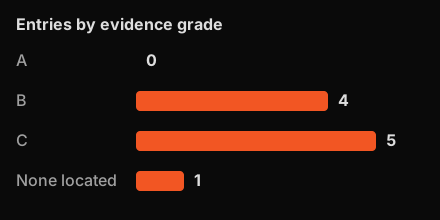
This document is mostly a list of things that are not established, and that is its use. Loose skin is the topic in this app with the widest gap between how confidently it is discussed and how little has been tested. The entries that carry a grade describe what skin does structurally after major weight loss. The entries about changing it carry the weakest grades in the whole MVIII corpus.
The strongest single finding here deflates the predictors. SK-F-04 is a scoping review of twenty-four studies. Pre-surgery BMI, time since surgery and the type of surgery were not significantly associated with how much excess skin bothered people, and the evidence for age, amount of weight lost and BMI was inconclusive. The confident causal story told everywhere about who gets loose skin and why is, at the level of published correlates, mostly not there.
The practices MVIII already runs are defensible, but two of them are defensible for a different reason than the app gives. The rate-of-loss cap is real and well supported, for lean mass. It is not supported as a way to prevent loose skin, and the app's own code says otherwise. See Where the app and this document meet.
One entry is direct evidence and is being asked to travel. SK-P-02 rests on a 16-week trial in which resistance training improved skin elasticity and dermal thickness. Those women were sedentary, middle-aged, and not losing weight, and their skin was aging rather than stretched. It is the best available support for what the app programs, and the distance between that population and a member who has lost fifty kilos is the caveat, not a footnote to it.
Nothing in this document supports removing excess skin. The only intervention with an established effect on excess skin is surgery, and the histology entries exist partly to explain why even that gives limited results.
The entries
SK-P-01Rate of loss is capped when excess skin is listed
PrescriptionNothing about the rate of loss changes when a member lists excess skin. They choose their weekly rate, the app builds the calories for the rate they chose, and the recommendation owned by BB-N-04 / PL-N-03 at 0.5 / 0.7 / 1.0 %BW/week is shown under the control and cited rather than applied. The only figure that overrides a member is a floor of 1,400 calories a day. Band: min "no guidance at all", standard "state the recommended rate, cite it, and use the rate the member chose", max "enforce the recommended rate".
Evidence gradeB
EffectAthletes losing 0.7% of bodyweight per week gained 2.1% ± 0.4% lean body mass, while those losing 1.4% per week were unchanged at -0.2% ± 0.7%, a significant difference between groups, with fat mass falling 31% and 21% respectively [6]. Both groups did four resistance sessions a week. A review of weight-loss-induced muscle loss reaches the same practical conclusion: adequate protein and exercise preserve muscle during weight loss, and resistance work also preserves strength [7].
Population24 elite athletes, 8.5 and 5.3 weeks; review across adults with obesity.
CaveatThe evidence here is about lean mass, not about skin. No trial has tested rate of weight loss against skin laxity as an outcome, so nothing in this entry licenses telling a member that losing slowly will leave them less loose skin. What is supported is that a slower cut holds more muscle, which is worth saying and is the reason the recommendation is shown at all.
An earlier version of this app went further and capped the rate at 1.0 lb per week whenever excess skin was listed, on the stated grounds that faster loss leaves more loose skin. That claim has no support in this document or anywhere else located, and the cap was removed rather than re-argued. A member who wants to lose faster than a pound a week is entitled to, and quietly feeding them the calories for a slower cut was answering a question they had already answered.
SK-P-02Resistance training is programmed to build tissue under the skin
PrescriptionWith excess skin listed, MVIII programs progressive hypertrophy work and applies no movement contraindications. Band: min "keep training at all", standard "progressive resistance work at hypertrophy volumes", max "supervised resistance training with dermal outcome measurement".
Evidence gradeC
EffectIn a 16-week trial comparing aerobic and resistance training in sedentary middle-aged women, both improved skin elasticity and upper dermal structure, and resistance training additionally improved dermal thickness and increased dermal biglycan [5]. Separately, both endurance and resistance training preserve muscle mass during weight loss, and resistance training also improves muscle strength [7].
Population56 healthy sedentary Japanese women aged 41 to 59, twice weekly, 16 weeks; and a review in adults with obesity.
CaveatThe dermal effects were measured in aging skin, not skin stretched by obesity and then emptied, and the resistance arm was not losing weight. The absolute changes were small. This entry is the best direct evidence available for what the app already does, and it is a long way from the population it is being applied to. It supports programming resistance work. It does not support telling a member their skin will tighten.
SK-P-03Protein stays at the training bands and is not raised for skin
PrescriptionListing excess skin does not change the protein target. Protein continues to come from BB-N-05 / PL-N-03b at 2.3 / 2.6 / 3.1 g/kg FFM/day in a deficit. Band: min "meet the deficit protein band", standard "meet the deficit protein band", max "meet the deficit protein band".
Evidence gradeB
EffectAcross 24 trials and 1,063 people, energy-restricted higher-protein diets mitigated the loss of fat-free mass by 0.43 kg (95% CI 0.09 to 0.78) against standard-protein diets at matched calories, alongside greater loss of body weight and fat mass [8]. High protein intake helps preserve lean and muscle mass during weight loss without improving muscle strength [7].
PopulationAdults ≥18 y in energy restriction, mean 12.1 ± 9.3 weeks.
CaveatThe band is already at the top of what the literature supports, and the reason is muscle, not skin. No controlled trial has tested protein intake against skin laxity as an outcome in any population. Raising protein further because a member has loose skin would be inventing a dose for an effect nobody has measured. See SK-X-01.
SK-P-04Loose skin is excluded from the body-fat estimate
PrescriptionA body scan is instructed that loose skin on the abdomen, arms or thighs reads like body fat on camera and must not be counted toward the body-fat estimate. Band: min "no adjustment", standard "exclude it from the estimate and never cue a deeper deficit", max "a validated correction factor".
Evidence grade—
EffectNo published correction for photographic body-fat estimation in the presence of redundant skin was located. The prescription is a measurement decision rather than a finding: the app declines to convert an artifact into a number that would then drive a target.
PopulationNot applicable.
Sourcesnone
CaveatThis entry carries no evidence and is listed anyway, because leaving it out would hide a decision that changes a member's calorie target. A photographic estimate that counted redundant skin as fat would overstate body fat, and the app's own macro chain would answer that by cutting harder, which is the exact failure this prescription exists to prevent. The honest description is that MVIII refuses to guess in the direction that does harm.
SK-P-05Excess skin is framed as evidence of what was achieved, never as fat
PrescriptionCoaching copy names loose skin as the result of a major accomplishment and never as fat to be burned off. Band: min "say nothing about it", standard "name it as the result of what they did and move on", max "structured body-image intervention".
Evidence gradeC
EffectAcross a scoping review of twenty-four studies, negative physical, psychosocial and daily-life impacts of excess skin were reported in 67%, 75% and 83% of studies respectively, and women reported more excess skin and greater inconvenience than men [3]. Patients who wanted body contouring had more excess skin and were less satisfied with their bodies [4].
PopulationAdults after bariatric surgery.
CaveatThese studies establish that excess skin carries a psychosocial burden. They do not establish that any particular framing relieves it, and no trial has tested coaching language against body satisfaction in this population. The prescription follows from the burden being real and from SK-P-04: an app that implied loose skin was fat would be both wrong and pointed at the wrong target. That is a floor, not a demonstrated benefit. SI- entries in self-image-programming.md cover the general case.
# PART B — Findings
SK-F-01Loose skin is a structural change in the dermis
FindingSkin from the epigastric region of patients after massive weight loss showed a reduction of thick collagen fibers (p = 0.048), an increase in thin collagen fibers (p = 0.0085), and increased elastic fiber density, against skin from patients with morbid obesity [1]. The authors' stated purpose was to explain why body contouring surgery gives limited results in this population.
Evidence gradeC
Population20 post-bariatric patients against 20 with morbid obesity, abdominal epigastric skin, morphometric analysis.
Sources[1]
CaveatObservational and small, and it compares two groups rather than following one. It is the mechanism entry: it describes what the tissue is, which is the ceiling every other entry sits under. A collagen network remodeled from thick organized fibers into thin ones is not a nutrition state and is not something a training block reverses.
SK-F-02How the weight came off may matter for elastin, and age confounds it
FindingComparing 80 skin biopsies from body-contouring procedures, patients whose massive weight loss followed bariatric surgery had significantly reduced elastic fiber content in abdominal skin against patients who lost the same proportion without surgery. Collagen content was equally reduced in both groups [2].
Evidence gradeC
Population77 patients, >50% excess weight loss, abdominoplasty and breast reduction specimens.
Sources[2]
CaveatThe surgical group was significantly older, which the paper reports and which is the obvious alternative explanation for lower elastin. This is a single prospective comparison with a known confounder. It is included because it is the closest thing in the literature to a test of whether the manner of weight loss changes the skin, and because what it suggests is narrower than the claim it will be used to support: a difference in elastin between two ways of losing a large amount of weight is not evidence that a slower diet prevents loose skin.
SK-F-03It is common, most people who want surgery do not get it
FindingExcess skin follows bariatric surgery in more than 70% of adults [3]. Of 590 post-bariatric patients, 368 (62.4%) desired body contouring surgery, 65 (11.0%) had undergone it, and 39.1% of those who wanted it had never consulted a plastic surgeon, of whom 44.1% met the weight criteria [4].
Evidence gradeB
PopulationAdults after bariatric surgery; Dutch prospective database, n = 590.
CaveatBoth are bariatric populations, and members who reached the same place through diet and training are not represented. The reason this entry is in a fitness app's specification is the gap between 62.4% and 11.0%: most people carrying this are not going to have it removed, which makes what they do in the meantime the relevant question and makes an app that treats it as a problem to be dieted away actively unhelpful.
SK-F-04Who gets it worse is largely not established
FindingIn a scoping review of thirteen quantitative and eleven qualitative studies, pre-surgery BMI, time since surgery and type of surgery were not significantly associated with the inconveniences of excess skin, and findings for other correlates including age, weight loss and BMI were inconclusive. The review's own conclusion is that evidence is lacking to determine who is at heightened risk [3]. In a separate retrospective series of 204 patients, Pittsburgh Rating Scale severity did correlate positively with maximum BMI, and deformities were greater after bariatric surgery than after diet and exercise alone (p = 0.031) [9].
Evidence gradeB
PopulationAdults after bariatric surgery; and 204 massive-weight-loss patients presenting for breast surgery, 2004 to 2015.
CaveatThe two sources disagree in emphasis and the designs explain it: [9] is retrospective, single-institution, breast-specific, and drawn from people who presented for surgery, which selects for severity. [3] is the broader synthesis and the more conservative reading. Nothing here licenses telling a member what their skin will do, or that anything they did caused it.
SK-F-05Collagen supplements have been studied, but never in this population
FindingA meta-analysis of 14 randomized double-blind controlled trials and 967 participants found that 12 weeks of hydrolyzed collagen supplementation improved skin moisture and elasticity against placebo [10].
Evidence gradeC
PopulationAdults in skin-aging trials. None in people who had lost a large amount of weight.
Sources[10]
CaveatPublished in a journal with a low acceptance bar, in a field with heavy industry funding, and measuring hydration and elasticity in aging skin rather than laxity in emptied skin. The entry exists to be precise about the gap: the honest statement is not that collagen supplements were tested for loose skin and failed, it is that nobody has tested them for it at all. MVIII sells no supplements and recommends none, so no prescription follows either way.
# Where the app and this document meet
MVIII changed three systems when a member listed excess skin, and all three predated this document. Writing it removed one of them, left two standing, and connected none of them to an entry id.
Do protein, slower weight loss or collagen fix loose skin?
None of the three has been shown to. They are the first three of seven skin claims MVIII leaves out.
SK-X-01— That protein deficiency causes loose skin, and that eating more protein will fix it. The visible skin changes of protein deficiency belong to protein-energy malnutrition, a disease of severe deprivation. It is not the state of an adult eating 2.3 to 3.1 g/kg fat-free mass, which is what MVIII programs in a deficit. No controlled trial has tested protein intake against skin laxity in any population. Protein preserves fat-free mass in a deficit [7], [8], and that is the claim that holds. The popular version borrows the mechanism of a disease to sell a dose to people who do not have it.SK-X-02— That slower weight loss prevents loose skin. Rate of loss has been tested against lean body mass [6], not against skin. The one comparison touching how the weight came off found an elastin difference confounded by age [2], and the broader synthesis found the obvious predictors unestablished [3]. MVIII enforced this claim in code until it was asked for a citation, which makes it the entry in this document with the most direct consequence for what the app does.SK-X-03— That collagen supplements tighten skin after weight loss. They have been trialed for hydration and elasticity in aging skin [10] and never in this population [3], [4]. The gap is the finding.SK-X-04— That resistance training removes excess skin. Resistance training improved elasticity and dermal thickness in sedentary middle-aged women who were not losing weight [5], and preserves muscle during weight loss [7]. Neither is removal, and the histology says why [1].SK-X-05— That vitamin C, zinc or copper stacks improve skin after weight loss. These are cofactors in collagen synthesis, which is a statement about biochemistry at deficiency, not a dose-response above adequacy. No trial of a cofactor supplement against post-weight-loss skin laxity was located.SK-X-06— That any predictor tells a member how much loose skin they will have. Pre-surgery BMI, time elapsed and surgery type were not significantly associated with its burden, and age, weight lost and BMI were inconclusive [3].SK-X-07— That body contouring surgery restores normal skin. The histology entries exist because it does not. Both [1] and [2] were written to explain why outcomes are limited, and [2] links reduced elastin to a higher risk of complications after contouring surgery.
The 10 sources, checked 26 August 2026
- Rocha RI, Junior WC, Modolin MLA, Takahashi GG, Caldini ETEG, Gemperli R. Skin Changes Due to Massive Weight Loss: Histological Changes and the Causes of the Limited Results of Contouring Surgeries. Obes Surg. 2021. https://doi.org/10.1007/s11695-020-05100-3
- Hany M, Zidan A, Ghozlan NA, et al. Comparison of Histological Skin Changes After Massive Weight Loss in Post-bariatric and Non-bariatric Patients. Obes Surg. 2024. https://doi.org/10.1007/s11695-024-07066-y
- Baillot A, Brais-Dussault E, Bastin A, et al. What Is Known About the Correlates and Impact of Excess Skin After Bariatric Surgery: a Scoping Review. Obes Surg. 2017. https://doi.org/10.1007/s11695-017-2814-3
- Monpellier VM, Antoniou EE, Mulkens S, Janssen IMC, Jansen ATM, Mink van der Molen AB. Body Contouring Surgery after Massive Weight Loss: Excess Skin, Body Satisfaction, and Qualification for Reimbursement in a Dutch Post-Bariatric Surgery Population. Plast Reconstr Surg. 2019. https://doi.org/10.1097/prs.0000000000005525
- Nishikori S, Yasuda J, Murata K, Takegaki J, et al. Resistance training rejuvenates aging skin by reducing circulating inflammatory factors and enhancing dermal extracellular matrices. Sci Rep. 2023. https://doi.org/10.1038/s41598-023-37207-9
- Garthe I, Raastad T, Refsnes PE, Koivisto A, Sundgot-Borgen J. Effect of two different weight-loss rates on body composition and strength and power-related performance in elite athletes. Int J Sport Nutr Exerc Metab. 2011. https://doi.org/10.1123/ijsnem.21.2.97
- Cava E, Yeat NC, Mittendorfer B. Preserving Healthy Muscle during Weight Loss. Adv Nutr. 2017. https://doi.org/10.3945/an.116.014506
- Wycherley TP, Moran LJ, Clifton PM, Noakes M, Brinkworth GD. Effects of energy-restricted high-protein, low-fat compared with standard-protein, low-fat diets: a meta-analysis of randomized controlled trials. Am J Clin Nutr. 2012. https://doi.org/10.3945/ajcn.112.044321
- Pang JH, Coombs DM, James I, Fishman J, Rubin JP, Gusenoff JA. Characterizing Breast Deformities After Massive Weight Loss: Utilizing the Pittsburgh Rating Scale to Examine Factors Affecting Severity Score and Surgical Decision Making in a Retrospective Series. Ann Plast Surg. 2018. https://doi.org/10.1097/sap.0000000000001338
- Dewi DAR, Arimuko A, Norawati L, et al. Exploring the Impact of Hydrolyzed Collagen Oral Supplementation on Skin Rejuvenation: A Systematic Review and Meta-Analysis. Cureus. 2023. https://doi.org/10.7759/cureus.50231