References · stillness
Stillness: the evidence
There is almost no evidence for MVIII's stillness session, and this page says so. The session is a timer, and brief unstructured stillness in healthy adults has no evidence located. What does hold up is slow breathing. Reviews of meditation programs find low evidence of no effect on sleep or focus, or too little evidence of any.
Is there evidence for MVIII's stillness session?
Almost none, and the page says so. The session is a timer, and brief unstructured stillness in healthy adults has no evidence located.
Entries by grade: A 3, B 3, C 6, none located 3. What the grades mean.
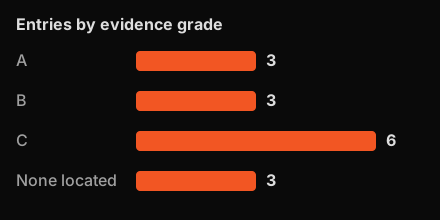
MVIII's stillness session is a timer, and almost nothing here is evidence for it. No breathing pace, no attention instruction, no technique. That is ST-P-01, and it is graded as having no evidence located, because brief unstructured stillness in healthy adults has none.
An earlier version prescribed paced breathing instead, graded A, on the strength of ST-F-01. That was the evidence layer picking the feature rather than bounding its claims: slow breathing was the best-evidenced thing nearby, so the app got built around it, and practice at stopping, which was the point, went unbuilt. The breathing rows are kept below because they are true and because somebody should be able to see what was traded away. They are not what the app does.
What the feature rests on is ST-D-01, and it is a claim about difficulty rather than benefit. Across 11 studies, people left alone with their thoughts for 6 to 15 minutes disliked it enough that many chose to give themselves electric shocks instead. Sitting still is hard. Something hard that a person cannot do yet and later can is a capability, which is how MVIII treats it, and a capability needs no health claim to be worth having.
Start with the finding that constrains everything else this document could otherwise have claimed. A review of 18,753 citations selecting 47 randomised trials with active controls and 3,515 participants found meditation programs produced moderate evidence of improved anxiety (effect size 0.38, falling to 0.22 at three to six months), depression (0.30, falling to 0.23) and pain (0.33); low evidence of improved stress and mental health-related quality of life; and low evidence of no effect, or insufficient evidence of any effect, on positive mood, attention, substance use, eating habits, sleep and weight [1].
And then the sentence that matters most to a training app: "We found no evidence that meditation programs were better than any active treatment (ie, drugs, exercise, and other behavioral therapies)" [1].
MVIII is a training app. The best-evidenced stress intervention it offers is the training. A stillness feature is an addition to that, not a substitute for it, and any copy implying otherwise is contradicted by the strongest source in this document.
What does hold up is narrower and more mechanical: slow breathing. A systematic review and meta-analysis screening 1,842 abstracts and including 223 studies found voluntary slow breathing increased vagally-mediated heart rate variability during the session, immediately after a single session, and after a multi-session intervention [2]. That is a physiological effect, measured, replicated at scale, described by its own authors as low-tech, low-cost, with few adverse effects expected. It is the reason this feature is a breathing protocol and not a meditation timer.
The sport-specific evidence is the weakest here and should not be leaned on. Nine trials of fair quality, 290 participants, with performance benefits demonstrated in shooting and dart throwing [3]. Nothing in it concerns lifting, and its physiological indices carried heterogeneity of I² = 98%, which is to say they cannot be interpreted.
Two entries carry no evidence at all and both are things MVIII is choosing to build. ST-P-05, whether stillness sessions improve any training outcome. ST-P-06, how long a session should be. Both were searched for. Both came back empty.
The entries
ST-P-01The session is unstructured stillness
PrescriptionA stillness session in MVIII is a timer and nothing else. No breathing pace, no attention instruction, no technique. The member sits until it ends.
Evidence grade—
EffectNo systematic review or controlled trial of brief unstructured stillness in healthy adults was located. The two adjacent literatures are both something else: ST-F-01 and ST-F-05 measure paced breathing, which is a protocol this feature does not run, and ST-F-02 measures instructed meditation courses of 20 hours and up, which this is not either.
PopulationNone.
SourcesNone.
CaveatsThe stillness session was previously a paced-breathing prescription graded A, and that was the evidence layer choosing the feature. A source standard exists to bound what the app claims, not to decide what it builds. Slow breathing is the best-evidenced thing in this area, so an earlier version of this document built the app around it, and the thing actually worth offering, practice at stopping, went unbuilt.
The honest position is that MVIII now does something with less behind it than the alternative it discarded, and says so here rather than borrowing the breathing evidence to cover it. What the feature stands on instead is ST-D-01: sitting with your own thoughts is difficult, measurably and for most people, and something difficult that gets easier with practice is a capability. SelfEvidence records it as one. That framing needs no clinical claim, which is fortunate, because there is none to make.
ST-P-02How the session length progresses
PrescriptionThe member picks a starting point, from 10 seconds up. Every completed session adds 10 seconds to the next one. They may start the run again from the same point, or choose a new starting point, at any time.
Evidence grade—
EffectNo study establishes a duration for unstructured stillness, or a rate at which to increase one. The nearest measurement is ST-D-01, where participants alone with their thoughts for 6 to 15 minutes disliked it enough that many self-administered electric shocks. That is a finding about difficulty at that duration, not a prescription of it.
PopulationNone.
SourcesNone.
CaveatsThe whole progression is a decision and is recorded as one. Ten seconds a session is chosen because it is small enough that the next session is never the one that breaks the run, which is the same reasoning WODProgramming.progressionStep uses for a rep and a metre, and no better evidenced here than there.
Ten seconds is on the starting menu without apology. If ST-D-01 is right, a menu whose smallest option was three minutes was never built for the people who find this hard.
Both ways out are offered on the same screen as the target, because a count that can only rise is a streak wearing a different hat. SI-P-12 records that MVIII has no streaks and why: the day it breaks is the day people stop opening the app. A run that can be restarted, from the same point or a lower one, without the app calling it a regression, is the same refusal applied to a number that would otherwise become one.
The target is derived from the log rather than stored beside it: start, plus ten seconds per completed session since the run began. Nothing to keep in step, nothing that can disagree with the history.
ST-P-03What a stillness session is scheduled against
PrescriptionA stillness session never displaces a training session and never counts toward the member's weekly training target. It is available on demand and, where scheduled, sits alongside training rather than instead of it.
Evidence gradeC · derived
EffectNo meditation program was shown to be more effective than exercise, progressive muscle relaxation, cognitive-behavioral group therapy or other specific comparators on any outcome examined [1]. Nothing establishes that stillness earns a training slot, so it does not get one.
PopulationNone. This row is an inference from the actively-controlled meditation review. [1]
Sources[1]
CaveatsDerived, and weaker than it first reads. The authors of [1] disclaim their own comparative null: those twenty trials averaged 37 participants per group and none was powered to assess equivalence or noninferiority, so nothing has been shown in either direction. This row is therefore a precautionary product decision and not an evidence-led one. The precaution is still the right way round: the training has evidence behind it, the stillness session has evidence for a physiological effect and nothing else, and the one with more behind it keeps the slot. But an app claiming the research told it to schedule this way would be overstating what the research says.
The SI- companion applies too. A member's session is the thing this app exists to protect, and adding a competing demand on the same time is a change to their week that no trial has justified.
ST-P-04What the app is allowed to claim
PrescriptionMVIII states that slow breathing shifts a measured physiological index, and states nothing about mood, sleep, attention, focus, recovery quality or training performance. Band: min "make no claim", standard "state the physiological effect and its limits", max "state the anxiety, depression and pain effects found in clinical populations".
Evidence gradeB
EffectThe ceiling is set by [1]: low evidence of no effect, or insufficient evidence of any effect, on positive mood, attention, substance use, eating habits, sleep and weight. The floor is set by [2]: a replicated increase in vagally-mediated HRV. Moderate evidence exists for anxiety, depression and pain [1], but in diverse adult clinical populations, which is not who opens a training app.
Population47 randomised trials with active controls, 3,515 participants, clinical populations [1].
CaveatsMVIII sits at standard rather than max deliberately. The anxiety and depression effects are real, they are in clinical samples, and importing a clinical effect size into a fitness feature is exactly the move this document exists to prevent. The app also does not measure HRV during a stillness session, so even the physiological claim is a claim about the technique in the literature, not about the member.
ST-P-05Whether stillness improves any training outcome
PrescriptionMVIII offers stillness sessions inside a training app. No evidence was located that they improve any training outcome.
Evidence grade—
EffectNo systematic review or controlled trial was located examining slow breathing or meditation practice and subsequent resistance training performance, recovery between sessions, or adherence to a training program. The nearest available evidence is in precision sports and is described at ST-F-03.
PopulationNone.
SourcesNone.
CaveatsSearched for specifically. This is the largest gap in the document and it sits directly under the feature's reason for existing inside this particular app. The honest position is that stillness is offered because slow breathing does something measurable and pleasant, not because it will make anyone stronger.
# PART B — Findings
ST-F-01Slow breathing raises vagally-mediated HRV, reliably
FindingAcross 223 included studies, voluntary slow breathing increased vagally-mediated heart rate variability during the breathing session, immediately after a single training session, and after a multi-session intervention [2].
Evidence gradeA
Population223 studies from 1,842 screened abstracts.
Sources[2]
CaveatsThe authors note the involvement of the parasympathetic nervous system in a large range of health outcomes, which is a statement about plausibility rather than about demonstrated benefit. Three separate time-point analyses is a genuine strength of this review.
ST-F-02The ceiling on what meditation has been shown to do
FindingForty-seven randomised trials with active controls, 3,515 participants. Moderate evidence of improved anxiety (0.38 at 8 weeks, 0.22 at 3 to 6 months), depression (0.30 at 8 weeks, 0.23 at 3 to 6 months) and pain (0.33). Low evidence of improved stress and mental health-related quality of life. Low evidence of no effect or insufficient evidence of any effect on positive mood, attention, substance use, eating habits, sleep and weight. No evidence that meditation programs were better than any active treatment, including exercise [1].
Evidence gradeA
PopulationDiverse adult clinical populations.
Sources[1]
CaveatsThe active-control requirement is what makes this the strongest source here and the most deflationary: many positive meditation findings come from comparisons against doing nothing. The effects that survive shrink at follow-up. This entry is the reason ST-P-04 exists.
Three qualifications from the full text that the abstract does not carry, and the first one cuts against how this row is usually quoted. The comparative-effectiveness null is weaker than "no better than exercise" makes it sound: the authors state that a lack of significant superiority addresses equivalence only if a trial is powered to detect a difference, and that sample sizes in those twenty trials averaged 37 per group and none appeared adequately powered to assess noninferiority or equivalence. The correct reading is that nobody has run a trial capable of separating them, not that they were separated and found equal.
Second, "meditation programs" is two things here. Mindfulness programs produced the effects above. Mantra programs, transcendental meditation included, did not improve any outcome examined, at low to insufficient strength.
Third, dose. The mindfulness-based stress reduction programs that produced these effects typically provided 20 to 27.5 hours of training across 8 weeks, and the authors note that participants in short trials "likely did not achieve a level of expertise needed to improve outcomes". See ST-F-06, which is the row that matters most to anything MVIII ships.
For scale rather than for comfort: the authors observe that an effect size of 0.22 to 0.38 is comparable to what an antidepressant achieves in a primary care population, where Fournier's patient-level meta-analysis found 0.11 for mild-to-moderate and 0.17 for severe depression against placebo. The effects are small. So are the effects of things people take seriously.
ST-F-03Mindfulness in sport, in precision sports only
FindingNine trials of fair study quality (mean PEDro 5.4, SD 1.1) with 290 healthy sportive participants across a wide range of sports. Large effects with narrow confidence limits and low heterogeneity for mindfulness scores (SMD 1.03, 90% CI 0.67 to 1.40, I² = 17%). Moderate to large effects for psychological performance surrogates (SMD 0.72, 90% CI 0.46 to 0.98, I² = 14%). Performance outcomes improved in shooting and dart throwing (SMD 1.35, 90% CI 0.61 to 2.09, I² = 82%). Physiological performance indices showed very large effects with confidence limits spanning almost the entire plausible range (SMD 3.62, 90% CI 0.03 to 7.21, I² = 98%) [3].
Evidence gradeC
Population290 athletes over 15 years of age; nine trials of fair quality.
Sources[3]
CaveatsThe physiological result is uninterpretable. An I² of 98% with a confidence interval from 0.03 to 7.21 means the studies disagree so completely that pooling them produces a number without meaning, and it should never be quoted as "SMD 3.62". The demonstrated performance benefit is in shooting and dart throwing, and the authors themselves limit their conclusion to precision sports and call for more high-quality trials. Nothing here supports a claim about lifting.
ST-F-04Reframing arousal beats trying to suppress it
FindingAn overwhelming majority of people believe trying to calm down is the best way to cope with pre-performance anxiety. Across studies involving karaoke singing, public speaking and mathematics performance, individuals who reappraised anxious arousal as excitement felt more excited and performed better than those who attempted to calm down. Minimal strategies, such as saying "I am excited" aloud or receiving the message "get excited", produced an opportunity mindset rather than a threat mindset and improved subsequent performance [9].
Evidence gradeC
PopulationKaraoke, public speaking and mathematics tasks. Not athletes and not a gym.
Sources[6]
CaveatsArousal reappraisal sits in tension with the rest of the document and is included for that reason. Before a heavy attempt, the evidence points away from downregulation and toward reframing arousal that is already there. It is a single-author paper across laboratory tasks, none of them physical performance under load, and it should not be turned into a pre-lift protocol. It is the reason MVIII does not place a calming exercise before a max-effort attempt.
ST-F-05What slow breathing does to how people feel
FindingThe systematic review of slow breathing in healthy subjects reports psychological and behavioral outputs alongside the physiological ones: increased comfort, relaxation, pleasantness, vigor and alertness, and reduced symptoms of arousal, anxiety, depression, anger and confusion. Its stated conclusion is that slow breathing enhances autonomic, cerebral and psychological flexibility, and it finds links between parasympathetic activity and central nervous system activity "related to emotional control and psychological well-being in healthy subjects" [4]. The autonomic half is increased heart rate variability and respiratory sinus arrhythmia; the central half is increased EEG alpha and decreased theta power [4]. The most supported mechanism for the cardiac side is strengthening of baroreflex homeostasis, with an effect on the vagal afferent pathway to frontal cortical areas more recently proposed [5].
Evidence gradeC
Population15 studies in healthy subjects [4]; mechanism review [5].
CaveatsST-F-05 was previously filed as "the proposed mechanism" and reported only the EEG and heart-rate findings, which under-read the source it cites. The psychological outputs above are in the review's own results, in healthy people rather than clinical populations, and at a dose measured in minutes rather than the twenty hours at ST-F-06. That is the finding closest to what a member opens this feature for, and leaving it out made the evidence look more hostile to the feature than it is.
The slow-breathing evidence is still graded C and the reasons matter. Fifteen studies out of 2,461 screened is a small base. The outcomes are self-reported states, not blinded measures. The review pools techniques rather than isolating one, so "slow breathing" here is a family. What it supports is a direction and a plausible mechanism, not a dose-response or a promise.
ST-F-06The dose that produced the effects, against the dose an app offers
FindingThe mindfulness-based stress reduction programs behind the anxiety, depression and pain effects in [1] typically provided 20 to 27.5 hours of structured training across 8 weeks, with other mindfulness trials providing about half that and transcendental meditation trials 16 to 39 hours across 3 to 12 months. The authors note that many included studies were short term, on the order of 2.5 hours a week for 8 weeks, and that participants "likely did not achieve a level of expertise needed to improve outcomes that depend on mastery of mental and emotional processes". Only 5 of 47 trials reported their trainers' actual meditation experience and only 6 reported teaching experience [1].
Evidence gradeA
Population47 randomized trials, 3,515 participants.
Sources[1]
CaveatsThe dose row is the one that most constrains what MVIII has built, and it is the reason ST-P-04 sits where it does. A stillness session in this app runs three to ten minutes with no instructor and no course. The interventions that produced measurable effects on anxiety and depression ran twenty hours and up, taught by somebody. The distance between those two things is not a detail, and no entry in this document licenses carrying a clinical effect across it. What MVIII's session has behind it is the pair that operate on the timescale it actually runs on: ST-F-01, the physiological effect measured during and immediately after a single session, and ST-F-05, the psychological outputs reported in healthy people at a dose measured in minutes. Neither is a clinical effect and neither should be dressed as one, but they are not nothing, and an earlier version of this document filed the second under a heading that said "mechanism" and quoted only its EEG findings.
ST-F-07No harms were reported
FindingOf the 47 trials, 9 reported information on potential harms of meditation programs. None reported any harms of the intervention [1].
Evidence gradeC
Population9 of 47 trials.
Sources[1]
CaveatsNine trials out of forty-seven is not a safety literature, and absence of reported harm in studies that mostly did not look for it is close to no information at all. It is recorded because a feature should state what is known about its downside, and what is known here is very little rather than nothing bad.
ST-D-01People do not like being alone with their thoughts
FindingAcross 11 studies, participants did not enjoy spending 6 to 15 minutes in a room by themselves with nothing to do but think. They enjoyed mundane external activities much more, and many chose to administer electric shocks to themselves rather than be left alone with their thoughts. The authors' conclusion: "Most people seem to prefer to be doing something rather than nothing, even if that something is negative" [6].
Evidence gradeB
Population11 studies, university and community samples.
Sources[6]
CaveatsST-D-01 is the entry the feature actually rests on, and it is a claim about difficulty rather than about benefit. It establishes that unoccupied time is genuinely hard for most people. It does not establish that practising it helps, that it gets easier, or that anything improves as a result. Laboratory conditions, an empty room, a stranger's instruction. What it licenses is treating "sat still for thirty seconds" as an achievement rather than as a rest, and nothing further.
ST-D-02The phone costs attention even when you do not touch it
FindingAcross two experiments, the mere presence of a person's own smartphone reduced available cognitive capacity, even when they successfully resisted checking it. The cost was highest among those highest in smartphone dependence [7].
Evidence gradeC
PopulationTwo experiments, undergraduate and community samples.
Sources[7]
CaveatsTwo experiments in one paper, on laboratory cognitive tasks rather than anything a member would notice. It is cited for one narrow purpose: it is why the instruction on screen says to put the phone down rather than to hold it, which would otherwise be an aesthetic preference.
ST-D-03"Dopamine addiction" is a story, and the effect it describes is small
FindingA meta-review of 34 reviews and 594 publications found that meta-analytic evidence overall suggests a small negative association between social media use and mental health, with effects that are complex and depend heavily on which indicators are measured [8].
Evidence gradeB
Population34 reviews, 594 publications.
Sources[8]
CaveatsIncluded because it argues against the most tempting way to sell this feature. The popular framing, that social media has produced a population of dopamine addicts who have lost the ability to sit still, is not what the evidence describes: the association is small, it is contested, and the dopamine mechanism attached to it in popular writing is not an established finding about a reward system. ST-D-01 is the honest support for this feature, and it is stronger for being narrower: it says sitting with your thoughts is hard, which was true in 2014 and needed no theory about phones to be true.
Does meditation improve sleep or focus?
The best review finds low evidence of no effect, or too little evidence of any effect. Sleep and focus are two of ten meditation claims MVIII does not make.
- That meditation improves sleep. Low evidence of no effect, or insufficient evidence of any effect, in 47 actively-controlled trials [1]. This is among the most common claims made by wellness features and it is not supported.
- That meditation improves attention or focus in healthy adults. Same finding, same review [1].
- That a meditation or breathing practice is a better stress intervention than exercise. No meditation program was shown to beat exercise or any other active comparator on any outcome [1]. The reverse is equally unshown: those trials averaged 37 participants per group and none was powered to detect a difference either way, so anybody settling this comparison in either direction is overstating it. Note also that the comparison was run on meditation. No trial here compared paced breathing to exercise at all.
- That breathing practice improves strength or resistance training performance. Nothing located, in either direction. Recorded at
ST-P-05. - That mindfulness improves athletic performance generally. The demonstrated performance effects are in shooting and dart throwing, from nine fair-quality trials in 290 participants, with the authors limiting their own conclusion to precision sports [3].
- That calming down is the right response to pre-performance nerves. Most people believe it; the available evidence points toward reappraising the arousal instead [9].
- That a short daily session delivers what the meditation trials measured. The effects in [1] came from 20 to 27.5 hours of instructed training across 8 weeks. Nothing establishes that three minutes on a phone is a smaller dose of the same thing rather than a different thing.
- That "meditation" is one intervention. Mindfulness programs produced the effects; mantra programs, transcendental meditation included, improved nothing examined [1]. A source reporting them as one number is averaging across things that did not behave alike.
- That people have been made incapable of stillness by social media dopamine loops. The meta-review evidence puts the social-media-to-mental-health association at small and contested [8], and the dopamine mechanism attached to it in popular writing is a story rather than a finding. The difficulty is real and was documented in 2014 without reference to phones [6]. MVIII sells the feature on that, not on the story.
- That a fixed breathing pace is optimal. The <10 breaths per minute figure is a literature inclusion criterion, not an optimised dose, and the rate at which the baroreflex effect is largest is individual [4][5].
The 9 sources, checked 25 August 2026
- Goyal M, Singh S, Sibinga EMS, et al. Meditation Programs for Psychological Stress and Well-being: A Systematic Review and Meta-analysis. JAMA Intern Med. 2014. https://doi.org/10.1001/jamainternmed.2013.13018
- Laborde S, Allen MS, Borges U, et al. Effects of voluntary slow breathing on heart rate and heart rate variability: A systematic review and a meta-analysis. Neurosci Biobehav Rev. 2022. https://doi.org/10.1016/j.neubiorev.2022.104711
- Bühlmayer L, Birrer D, Röthlin P, Faude O, Donath L. Effects of Mindfulness Practice on Performance-Relevant Parameters and Performance Outcomes in Sports: A Meta-Analytical Review. Sports Med. 2017. https://doi.org/10.1007/s40279-017-0752-9
- Zaccaro A, Piarulli A, Laurino M, et al. How Breath-Control Can Change Your Life: A Systematic Review on Psycho-Physiological Correlates of Slow Breathing. Front Hum Neurosci. 2018. https://doi.org/10.3389/fnhum.2018.00353
- Lehrer PM, Gevirtz R. Heart rate variability biofeedback: how and why does it work? Front Psychol. 2014. https://doi.org/10.3389/fpsyg.2014.00756
- Wilson TD, Reinhard DA, Westgate EC, et al. Just think: The challenges of the disengaged mind. Science. 2014. https://doi.org/10.1126/science.1250830
- Ward AF, Duke K, Gneezy A, Bos MW. Brain Drain: The Mere Presence of One's Own Smartphone Reduces Available Cognitive Capacity. J Assoc Consum Res. 2017. https://doi.org/10.1086/691462
- Meier A, Reinecke L. Computer-Mediated Communication, Social Media, and Mental Health: A Conceptual and Empirical Meta-Review. Communication Research. 2021. https://doi.org/10.1177/0093650220958224
- Brooks AW. Get excited: Reappraising pre-performance anxiety as excitement. J Exp Psychol Gen. 2014. https://doi.org/10.1037/a0035325